
VLADIVOSTOK AND PRIMORSKY REGION: DEFINITION OF THE MAIN WAY FOR FUTURE DEVELOPMENT
Nikolai I. Pereslavtsev
Admiral Nevelskoy Maritime State University, Vladivostok
Abstract:
Based on the priorities put forward by Russian President at the 27th St. Petersburg Economic Forum (10 directions) [6], the author conducts his own analysis of the future development for Vladivostok and Primorsky Region. The author does not deny the need to draw up strategic economic plans for the Far East, but emphasizes the importance of defining tactical steps in this process. The definition of such tactical limits is necessary, in the author’s opinion, for the rational allocation and
expenditure of available resources of the state and private business, including for the long term. For Russia the revival and expansion of production in Vladivostok and Primorye Region may serve as inevitable tactical steps to the final goal of the whole Russian Far East prosperity. The suggestion to compile a detailed register of privatized enterprises within each subject of the Russian Federation to assess their effectiveness under the current ownership is also noteworthy.
Keywords: plans of development for Vladivostok and Primorye, Far East, revival of production, business-community
The peculiarities and requirements of the global situation of the last 5 years (since the beginning of covid pandemic) have once again highlighted to the federal center the importance of providing full and comprehensive: political, financial attention to the Far East, in order to help the region cope with the international challenges in the interests of all Russia.
Today we should not only define the ways to fulfill this task. We should determine among them the most real ones, so that their list does not turn into another set of loud slogans and promises. Vladivostok’s “Master- plan”, the “Greater Vladivostok” project and other proposals of this kind include the large-scale investments, an increase in wages and the city’s population by almost 4 times [1], the renovation of airports and extensive housing construction.
Such programs are probably necessary to indicate strategic milestones towards which one can and should strive. On the one hand, the question arises: how real are all these plans, and what we will succeed to see in the near future, while the older generation has not gone yet? From the other hand, «a journey of a thousand miles begins with the first step» [4].
That is, we should not only see the final goal, but also know how to reach it, identify tactical steps that may not be so impressive, but are more realistic and allow us to lay a solid foundation for further progress. The Russian President has said about it at St.Petersburg Forum: it is necessary to determine a clear understanding of “where we should go”.
The words of the great Russian literary classic come to mind. “True, at intervals he would say, while gazing from the verandah to the courtyard, and from the courtyard to the pond, that it would be indeed splendid if a carriage drive could suddenly materialize, and the pond as suddenly become spanned with a stone bridge, and little shops as suddenly arise whence pedlars could dispense the petty merchandise of the kind which peasantry most need. And at such moments his eyes would grow winning and his features assume an expression of intense satisfaction. Yet never did these projects pass beyond the stage of
debate”. [3]
Conclusion: you may adopt a lot of plans, but without analyzing the real state of things and all existing factors it becomes problematic to expect the implementation of these plans.
That is exactly where the expert community can help those who make political and economic decisions – in analyzing these factors. The joint efforts of officials and experts in this direction will serve the interests of citizens living in the region and in Russia as a whole.
Taking into account the above, let’s take a close look at some of the features of the situation around the city of Vladivostok and, more broadly, the Southern part of Primorye Region.
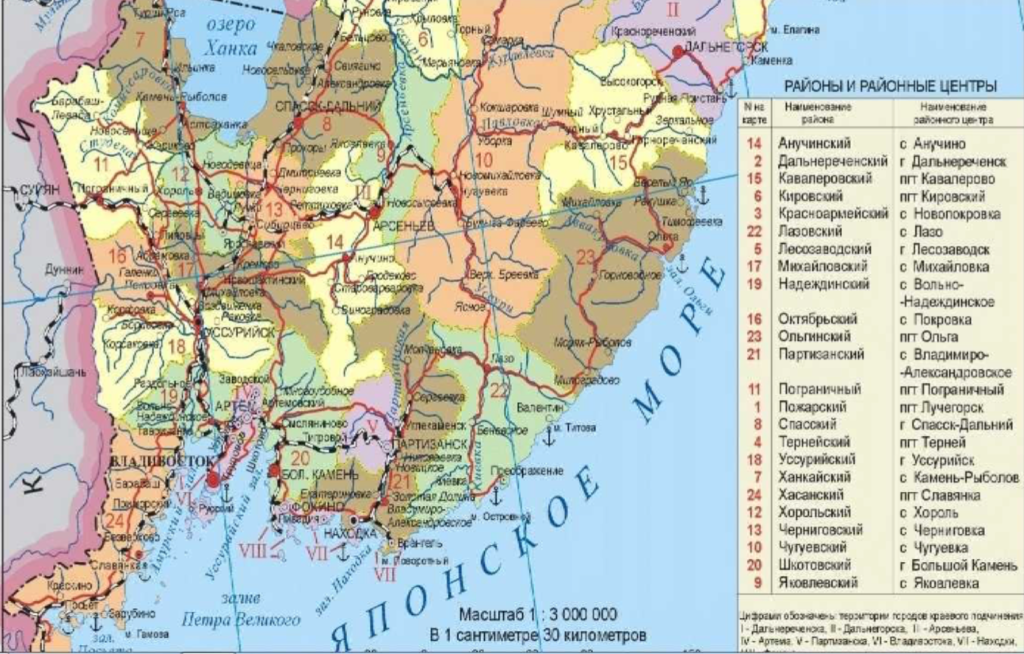
Strategic importance of Primorye for Russia may be compared with the importance of the Crimea and Novorossia on the Black Sea. Regardless of the turns in politics, our country cannot afford either partially or completely to lose these “Gates to the Pacific Ocean”. On this occasion, back in the 19th century, the Russian Emperor Nicholas I accurately noted: “where the Russian flag was once raised, it should not descend” [2].
However, despite all efforts, we cannot get rid of disturbing phenomena in the Far East. The remoteness of the Region from Central Russia creates problems with transport communication, which affects economic ties and the population’s standard of living. Due to this, the trend for depopulation still exists. Not only this reduces the volume of the domestic market. We are seeing an outflow of qualified specialists and a drop in the number of available labor. To implement their projects, employers have to import migrants from Central Asia, whose number, especially in cities, is gradually increasing. The measures at the federal level to attract the necessary specialists to the Region (doctors, teachers, etc.) are clearly insufficient. At the same time, everyone who has visited or lived in small towns or villages in Primorye (the city of Bolshoy Kamen with its Zvezda shipbuilding complex is a happy exception) knows that there is clearly no surplus of jobs there. To feed their families, people are hired to work in nearby cities, for example on a “shift basis”. Pensioners who live due to backyards and private farming remain in the village.
In these conditions, the most promising for Vladivostok and Primorye may be not transport and trade, and, moreover, not a tourist “cluster”. All these things are probably needful and important.But the priority should be given to the revival of industrial manufacturing and agricultural production in the region, including its logistical aspects.
Why manufacturing?
We are accustomed to use the terms “investments”, “investors” etc., who just need to be interested, and they will line up to invest their money. Especially popular to a certain point of time was the topic of foreign investments. However, we should not forget: the investor comes when he sees the chance of gaining profit or (if the investments are domestic) when he is motivated by patriotic reasons. What will a foreign private corporation gain (in addition to political positive for its state) from investing billions in a certain project on the Russian territory, the implementation of which will take at least several years?
Therefore, it is more promising to rely on patriotism, that is, not on foreign, but on domestic capabilities and resources.
Everyone understands that a lot is to be done for the economic recovery of the Far East, and very large investments from the federal center and domestic business will be needed. Where can we get them from? In this regard, in his speech in St. Petersburg, the President outlined, within 10 directions of economic development, a set of measures to expand the domestic resources of the Federation subjects which they could invest in their economy [6].
But this is only a first step, aimed at the process launch. At the next stage, the manufacturing sector should help to fill the domestic regional market with goods and financial resources.
In order to launch its own production, the Region will first have to invest. But then the process reaches the level of self-sufficiency. The volume of taxes collected is expanding, new jobs are being created. Businessmen invest the profits they receive in renovation of their enterprises and increase of their returns.
One needs to work with business: monitor the processes taking place in their environment, formulate and propose solutions that meet their needs at that time.
We do not call for a revision of “privatization” results. Russian leadership has expressed its opinion on this item [5]. But is it difficult for the Government to monitor each Russian region and compile a comprehensive list of enterprises that were privatized in the 1990s? Financial and material assets on many of them have since been repeatedly resold, the areas are not used according to the primary profile and inefficiently. Can the Federal Center, basing on such an assessment, transfer these enterprises to other owners who are actually ready to work for the country?
Firstly, we don’t invent something new. It is known that after the start of Ukrainian military operation, when some foreign companies left Russia, the Russian authorities began to consider the ways to nationalize their property on Russian territory and then to transfer it to domestic business.
The author is aware of the offers of some Primorye businessmen in the field of shipbuilding, ship repair, production of spare parts for automobile and construction equipment to take on long-term lease the empty areas of devastated industrial facilities (both in Vladivostok and in the regional districts), place machine tools in workshops and, in the future, deploy industrial production using own or borrowed funds (bank loans). At the same time, businessmen even declared their readiness to launch a vocational training system for their facilities. Can the Government, in response to a well-developed “Business-plan”, provide additional assistance to the businessmen in this area? For example, by reducing loan rates or providing preferential rental rates for premises used for training?
What kind of production can be entrusted to local business? Anything, including things necessary for the Russian Armed Forces. We don’t mean only the weapon of the battlefield (small arms, guns, tanks, shells, etc.). But to establish, for example, the production of spare parts for marine and river vehicles, drones, radio equipment, high-quality military uniforms, Russian local business is quite capable. The problem is that after privatization, these areas of devastated enterprises repeatedly changed their owner, and now it can be difficult to find with whom it is necessary to negotiate. In such cases, it would be appropriate to have legal assistance available to the businessman so that he does not knock on numerous “locked doors.”
The last 30 years made clear the fact that many production chains in the economy of the Russian Federation, as a whole, and Primorsky Region, in particular, have been destroyed and they need to be created anew. We will not give examples, let’s just say that the reconstruction of production relationships in the Region is already underway.
(End of introductory fragment)
 marinejournal.info