
TRANSITION FROM NATURAL GAS TO HYDROGEN: SOLUTIONS FOR ENVIRONMENTAL AND ENERGY SUSTAINABILITY
Dmitrii M. Lazarev
Public joint stock company NOVATEK, Moscow
Abstract: The article presents an analysis and discusses
prospects for the transition from traditional energy sources, in
particular natural gas, to the use of hydrogen as an alternative and
environmentally sustainable option. It is based on a review of current
trends in the field of energy, an in-depth study of the possibilities of
hydrogen energy and its prospects in the context of reducing
greenhouse gas emissions.
Starting with an overview of current problems associated with
the use of natural gas and the need to find environmentally safer
alternatives, the author continues with the analysis of technologies
for the production, storage and use of hydrogen. Various methods for
hydrogen production are described, as well as the possibility of its
industrial application, in particular, in the field of energy, transport
and machine building.
The article also assesses the economic and environmental
benefits of the transition to hydrogen energy, highlighting the key
factors facilitating this transition and overcoming possible obstacles.
Finally, it offers recommendations for making strategic decisions at
both the public policy and business levels for the successful and
sustainable implementation of hydrogen energy.
Keywords: LNG, hydrogen, carbon intensity index, maritime
shipping, environmentally sustainable energy source.
The problems of energy and environmental sustainability are
becoming increasingly relevant today. Climate change, pollution and
depletion of natural resources require the search for new, more
efficient and environmentally friendly sources of energy. The
liquefied natural gas (LNG) industry has seen rapid development in
recent years. Total global gas liquefaction capacity in 2022 Carbon
intensity reached an impressive 472.4 million tons per annum across
77 LNG terminals, while global re-gasificaton capacity continued to
grow to reach 902 million tons per annum. The fleet of ships
specializing in LNG transportation at the end of 2022 showed an
increase of 10%, with 641 ships in operation. Ports and terminals are
looking to adapt to the expected increase in demand for LNG
bunkering, with LNG bunkering facilities being established around
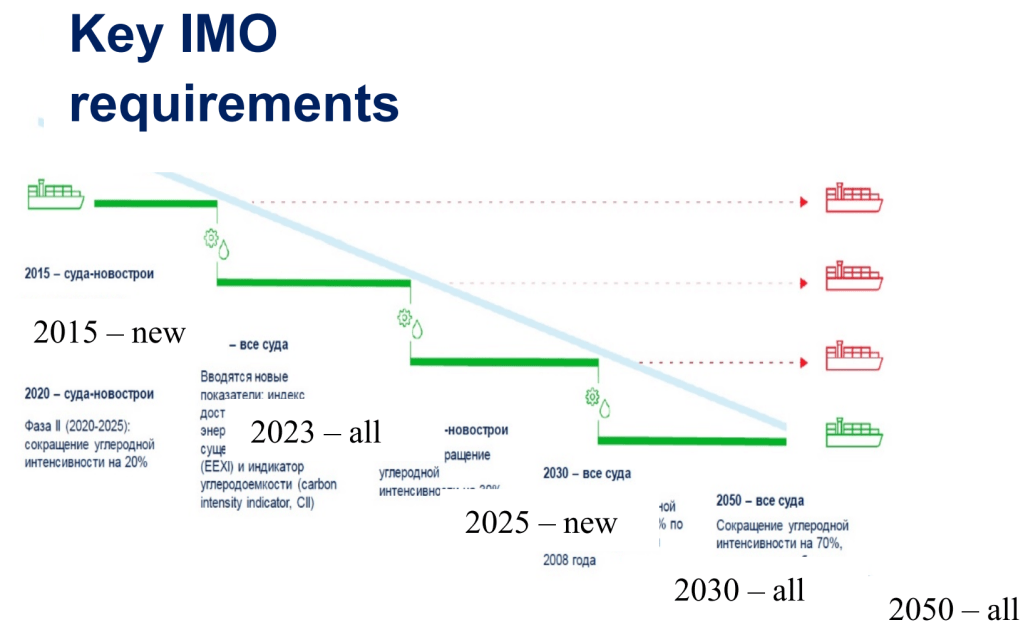
the world.In 2020, the International Maritime Organization approved
a roadmap to reduce the carbon footprint of international shipping
until 2050. The industry is forced to respond to changes taking into
account regulatory, financial and commercial factors. On 1 January
2023, it became mandatory for all ships to calculate their Energy
Efficiency Existing Ship Index (EEXI) to measure their energy
efficiency and trigger the collection of data to report their annual
operational Carbon Intensity Index (CII) and CII rating. (Figure 1)
In the context of further reducing the carbon footprint of
international shipping in accordance with DNV forecasts (Figure 2.),
the use of alternative fuels with a lower carbon footprint such as
hydrogen does not seem to be a rather distant prospect [1].

Explanatory notes to Fig.2
Marine fuel consumption forecast (DNV),
EJ per annum
*Electricity *Low carbon fuel
*Biofuel *LNG, LPG
*Oil fuel (FO/MGO/MDO)
Hydrogen represents a revolutionary solution to overcome the
challenges posed by climate change and guarantees energy security
as well. Its use has the potential to significantly reduce emissions and
ensure a sustainable and green future. As the most abundant chemical
element in the universe, hydrogen has a number of important
advantages. It is present in vast quantities on Earth, especially in
molecular compounds such as water, and is certainly a clean and
environmentally friendly type of fuel that does not emit harmful
substances when burned.
The main advantages of hydrogen-based solutions are:
Hydrogen will allow diversification of energy sources around
the world by increasing the share of renewable energy sources in the
energy consumption structure and will contribute to the
decarbonization of exported energy. The hydrogen-based economy
will facilitate technological progress and promote innovative
business solutions through the development of the clean technology
sector and the corresponding ecosystem from start-ups to
multinational corporations. This will stimulate economic growth in
the long term. The implementation of hydrogen projects will lead to
a reduction in carbon dioxide emissions and improved air quality in
cities and suburban areas. This is one of the best in the short list of
available options to decarbonize traditional industries.
Hydrogen has high energy potential and can be used in a
variety of sectors, including transport, industry and energy, while at
the same time it is a versatile fuel as it can be produced from a
variety of energy sources, including renewable sources such as solar
and wind energy. The main advantage is that it does not emit
greenhouse gases during combustion, which makes it more
environmentally friendly compared to traditional fuels.
(End of introductory fragment)
 marinejournal.info