
TRANSFORMATION OF THE NORTHERN SEA ROUTE INTO A TRANS-ARCTIC TRANSPORT CORRIDOR: CONDITIONS AND OPPORTUNITIES
Sergei N. Leonov
Economic Research Institute
Far Eastern Branch of the Russian Academy of Sciences, Khabarovsk
Elena A. Zaostrovskikh
Economic Research Institute
Far Eastern Branch of the Russian Academy of Sciences, Khabarovsk
Abstract: This article examines the transformation of global maritime transport corridors in modern conditions. A model for the development of the Trans-Arctic Transport Corridor is presented, along with some of the risks associated with implementing this project.
Keywords: maritime transport corridors, transit cargo, Northern Sea Route
Introduction
In September 2025, at the 10th Eastern Economic Forum, Russian President Vladimir Putin first voiced the idea of a Trans-Arctic Transport Corridor (TTC) project, which would be created on the basis of the Northern Sea Route [1]. The essence of the TTC project is the development of production facilities in the Russian Arctic Zone, which will ensure transport capacity, remove infrastructure barriers, and attract international shipping. Shipyards fulfilling orders for the construction of icebreaker and merchant vessels will provide additional impetus for the project, ensuring national security.
The need to form the Trans-Arctic Transport Corridor was dictated not only by the sanctions against Russia, but also by large-scale changes in global maritime space.
Problem Statement
Until recently, it was believed that the configuration of the maritime transport corridor network had reached a certain level of stability, with main and secondary transport routes forming a relatively stable system of cargo flow distribution, and seaports and shipping companies ensuring regular cargo deliveries. However, in recent years, the global maritime transport network has faced a number of challenges (the global financial crisis, sanctions wars, geopolitical conflicts, and the emergence of new mega-alliances in the container shipping sector), culminating in the COVID-19 pandemic and its multifactorial consequences. All of this has led to a disruption in the existing supply chain, increasing the number of bottlenecks on main and secondary routes [2, 3] (Fig. 1).
Northeast Asian countries (NEA) have experienced a double shock to maritime logistics, resulting in difficulties in transporting cargo on both main and secondary routes. For example, blockages in the Suez Canal on the main East Asia–Western Europe route have forced shipping companies to reroute maritime shipments over longer distances, resulting in a loss of time, serious disruptions to the supply chain, and increased freight rates.
Sanctions against Russia have exacerbated problems with transport infrastructure on secondary routes. This has contributed to both the development of intermodal shipping routes bypassing Russia and the intensive development of the Northern Sea Route and Russia’s inland waterway transport corridors.
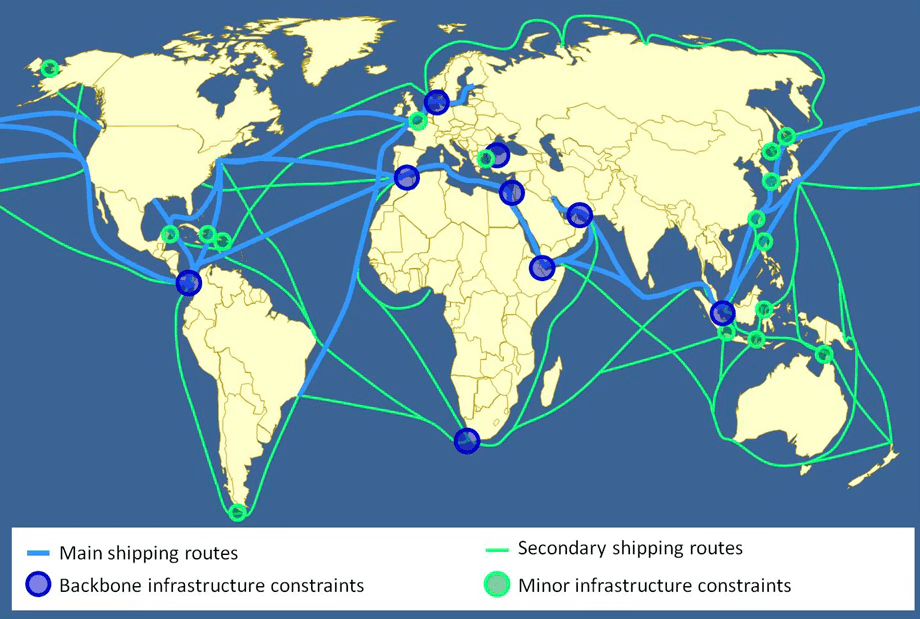
Fig. 1. Maritime transport routes and infrastructure constraints
Source: compiled by the author
In fact, the world is currently on the threshold of a shift in the East-West logistics paradigm, which is reflected in the shift in global transport routes toward Asian countries, a certain decline in the importance of the Suez Canal, and a growing interest in alternative transport corridors. It’s no coincidence that the Northern Sea Route is increasingly becoming the focus of practical and academic discussions.
In Russia, in the context of the transformation of international transport corridors, the Northern Sea Route will be transformed into the “Trans-Arctic Transport Corridor,” aimed at diverting some global transport flows.
The essence of the TTC project is the development of industrial facilities in the Russian Arctic Zone, which will ensure transport capacity, remove infrastructure barriers, and attract international shipping. Shipyards fulfilling orders for icebreaker and merchant fleet to ensure national security will provide additional impetus.
Discussion of Research Results
1. Formation of a New Model for the Trans-Arctic Transport Corridor
Formation of a new model for the Trans-Arctic Transport Corridor will require specific financial, organizational, and scientific efforts, as well as the synchronization of development plans based on the triad “cargo base – fleet – transport communications.»
In the classical sense, the formation and development of the Trans-Arctic Transport Corridor should go through three stages.
The first stage involves creating a “skeleton” of transport communications to meet national transportation needs, determining the volume of transported goods by mode of transport and region, and establishing a management system. The second stage involves creating a transport service, which generates additional cargo volumes. The third stage completes the development of the international transport corridor.
If we consider the economics of the interaction between the seaport and the adjacent region, then in the first stage, the port processes mineral resources that do not require transport and logistics services or technological modernization of the transport infrastructure. The region derives profit from the transshipment of basic cargo, Fig. 2.
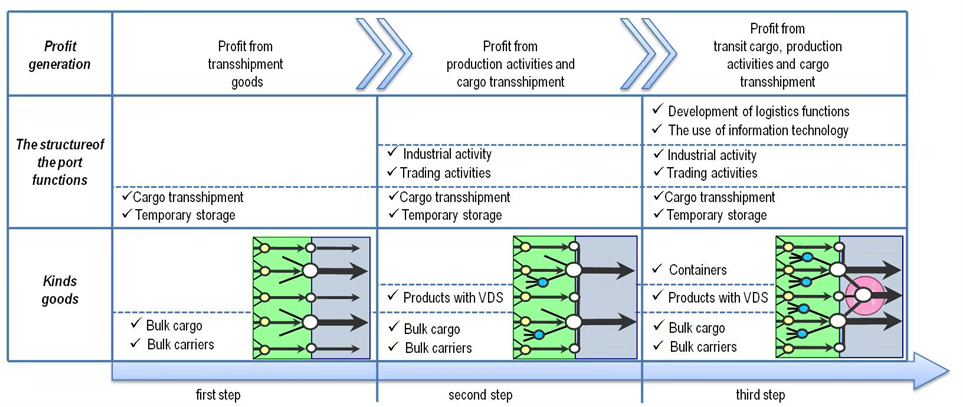
Fig. 2. Key stages in the development of Arctic ports and support zones
Source: compiled by the author
In the second stage, the development of manufacturing facilities in the Russian Arctic Zone creates additional transport flows, requiring the development of additional infrastructure capacity using innovative technologies. In addition to the main types of transported cargo, goods produced in the Arctic support zones are added. Accordingly, the region will receive profits from related industries.
In the third stage, the established transport infrastructure becomes attractive not only for regional and national cargo, but also for international transit. From a regional economic perspective, the most profitable income comes from transport and logistics services (stage three).
According to the classical theory of international transport corridor development, the NSR is currently at the beginning of its third stage, in the process of creating logistics corridors that provide inter-regional connections, enabling all types of transportation and the provision of all types of logistics services.
For the effective functioning of the TTC in the future, hub ports must be created at the entry and exit points of the Arctic highway to service international traffic flows [4].
It is important to understand that, as transport corridors develop, they generate not only positive effects (reducing transport costs, increasing the region’s transport accessibility, promoting employment growth, improving logistics services, and attracting other types of activity to the region), but can also trigger heterogeneous effects, whereby the end nodes of a transport corridor may receive greater benefits than the transit regions and countries through which the corridor passes [5-8].
2. Risks in the Implementation of the TTC project
Overall, commercial shipping in the Arctic is currently technologically feasible, but there is a lack of both reliable and supporting infrastructure necessary to make this option attractive.
The main challenges in implementing the TTC project include a number of internal and external risks.
Internal risks. A 40% reduction in distance using the NSR for shipping cargo from Europe to Asia does not yet guarantee a reduction in operating costs. The main constraints include navigation skills, icebreaker support, bunker fuel prices, and weather conditions.
External Risks. The first significant external risk to the implementation of the TTC is associated with the “Arctic 2050” project, presented in 2023 by the Korea Institute of Marine Science and Technology [9]. The Arctic initiatives encompass a wide range of topics, from forecasting climate change to developing environmentally friendly vessels for shipping in the Arctic Ocean. However, one aspect remains unclear: is ROK interested in and willing to cooperate with Russia in these areas?
The second significant external risk to the implementation of the TTC project could be China’s “One Belt, One Road” Initiative.
Firstly, one of the nine China-Arctic Ocean-Europe transport corridors being implemented by China will run outside Russian waters and will not involve interaction with Russian seaports.
Secondly, the implementation of several infrastructure projects (the construction of a railway from Rovaniemi (Finland) to Kirkenes (Norway) and the Helsinki-Tallinn tunnel, in combination with the construction of a railway from the port of Piraeus (Greece) to Central and Eastern Europe) could complete a single transport ring connecting the Mediterranean Sea with the Arctic Ocean (Fig. 3).
If the Belt and Road Initiative is successful, China will be given a central position in the geopolitical space of Asia and the world, sharply worsening the economic and geographic position of the Trans-Arctic Transport Corridor.
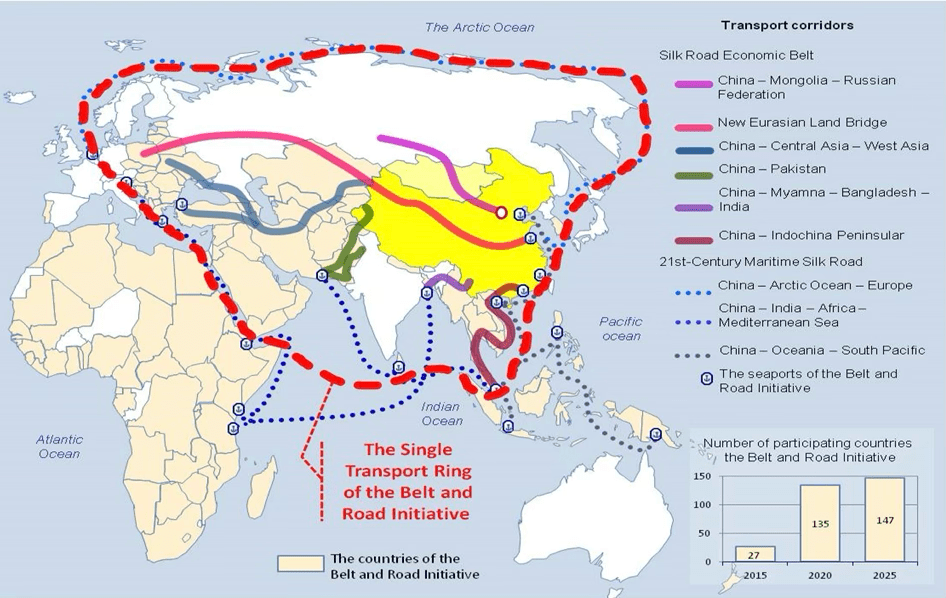
Fig. 3. The Belt and Road Initiative’s integrated transport ring.
Source: compiled by the author
Since 2013, China has been implementing the “One Belt, One Road” mega-project, which aims to create transportation links through infrastructure development and cooperation between countries along emerging international economic corridors. Six land and three maritime transport corridors are being developed within the “One Belt, One Road” Initiative. If implemented, the transport projects will reduce travel time along the economic corridors by 12% and increase trade volume by 3 to 10%. In 2025, 147 countries and 32 international organizations became partners of this Initiative, signing more than 200 cooperation documents and agreements with China [10]. Currently, the Initiative covers an area that generates 55% of the global gross national product, is home to 70% of the planet’s population, and contains 75% of known energy reserves. In total, China’s government spending on the implementation of the Initiative’s projects will exceed $1 trillion [11]. “One Belt, One Road” is expected to further shift the global economic center of gravity [12] and expand intercontinental trade flows through two pillars: the Silk Road Economic Belt and the 21st Century Maritime Silk Road.
REFERENCES
1. Zaostrovskikh E.A. 10 Eastern Economic Forum, “Spatial Economy“, 2025, vol .21, No 3, pp. 184–187/ Заостровских Е.А. 10 Восточный экономический форум, «Пространственная экономика», 2025, т.21, №3, сс. 184-187, URL: https://dx.doi.org/10.14530/se.2024.3.184-187
2. Samoylenko P. Yu. The role of the Russian Far East in the development of cooperation with the Asia-Pacific region and image promotion of Russian “Pivot to the East” policy: maritime transport aspect / P. Yu. Samoylenko, “Asia-Pacific Journal of Marine Science& Education”, 2025, vol. 15, №1, pp. 46–58
3. Zaostrovskikh E.A. Maritime transport corridors: changes and development prospects in the context of the modern economy, “Problems of socio-economic development of Siberia”, 2025, № 1. pp. 24–32 / Заостровских Е.А. Морские транспортные коридоры: изменения и перспективы развития в условиях современной экономики, «Проблемы социально-экономического развития Сибири», 2025, №1, сс. 24–32
4. Leonov S.N., Zaostrovskikh E.A. The Impact of Northern Sea Route Ports on the Formation of Focal Zones for Development of the Eastern Arctic, “Arctic: Ecology and Economy”. 2021, vol. 11, № 1, pp. 4–16 / Леонов С.Н., Заостровских Е.А. Влияние портов Северного морского пути на формирование очаговых зон освоения Восточной Арктики, «Арктика: экология и экономика», 2021, т. 11, № 1, сс 4–16
5. Leonov S.N., Zaostrovskikh E.A. Has China’s Belt and Road Initiative Acquired the Features of an Economic Corridor?, “Regionalistica”, 2025, vol. 12, №3, pp. 89–107, URL: http://dx.doi.org/10.14530/reg.2025.3.89 / Леонов С.Н., Заостровских Е.А. Приобрела ли китайская инициатива «Один пояс, один путь» черты экономического коридора?, “Регионалистика”, 2025, т. 12. № 3, сс. 89–107, URL: http://dx.doi.org/10.14530/reg.2025.3.89
6. The Web of Transport Corridors in South Asia, The World Bank, 2018, URL: https://doi.org/10.1596/978-1-4648-1215-6
7. Neretin A.S., Zotova M.V., Lomakina A.I., Tarkhov S.A. Transport Connectivity and Development of the Eastern Regions of Russia, Bulletin of the Russian Academy of Sciences, Geographical Series, 2019, № 6, pp. 35–52 / Неретин А.С., Зотова М.В., Ломакина А.И., Тархов С.А. Транспортная связность и освоенность восточных регионов России, Известия РАН, Серия географическая, 2019, № 6, сс. 35–52
8. Crescenzi R., Andres R.-P. Infrastructure and regional growth in the European Union. Papers in Regional Science, 2012, № 91(3), pp. 487–513
9. Kiryanov O.V. New aspects of the Arctic policy in the Republic of Korea, “Koreanology”, 2023, №2 (3), pp. 72-89 / Кирьянов О.В. Новые аспекты арктической политики Республики Корея, «Корееведение», 2023, № 2 (3), cc. 72–89
10.Nedopil C. Countries of the Belt and Road Initiative. Shanghai, Green Finance & Development Center, FISF Fudan University, 2025, Available at: http://www.greenfdc.org
11.Buranelli F.C. One Belt, One Road and Central Asia: Challenges and Opportunities. In: “The Belt & Road Initiative in the Global Arena”, Singapore, 2018, pp. 207–230. URL: https://doi.org/10.1007/978-981-10-5921-6_12
12.Minakir P.A. World economy: ideal storm, “Spatial Economy, 2022, vol.18, №2, pp. 7-37 / Минакир П.А. Мировая экономика: идеальный шторм, «Пространственная экономика», 2022, т. 18, № 2, сс. 7–37

