
THE TUMANGAN PROJECT AS A TOOL FOR CROSS-BORDER INTERACTION IN NORTHEAST ASIA
Larisa V. Zabrovskaya
Institute of History, Archaeology and Ethnography, Far Eastern Branch of the Russian Academy of Sciences, Vladivostok
Abstract: The most significant events related to the implementation of the Tumangan project are analyzed. It was expected that the implementation of this project would have a stimulating effect on the Chinese regional economy and increase the rate of economic growth in other countries of Northeast Asia. The evolution of Chinese tactics and strategy for solving the problems of the Tumangan project is traced. The conceptual basis of modern Chinese policy to revive the original goal of the project is revealed. Currently, China believes that the development of cross-border tourism and public diplomacy, which do not require significant capital investments, can solve many of the problems of the project. Chinese regional authorities are striving to transform their sector of the Tumangan project into an attractive zone of cross-border cooperation in the field of tourism and humanitarian exchange. This project may also be linked to China’s other Belt and Road initiative. New mechanisms for implementing economic development in the Chinese-North Korean border regions are studied. It is explained why Russian Primorye is not included in the network of Chinese local projects. An assessment is given of the mobilization of transnational ties among Chinese Koreans, and attention is drawn to the active support of this process by the Chinese authorities. The methods used by the Chinese side to involve the DPRK in the project are revealed, and the reasons why other Northeast Asian countries are not eager to participate in this Chinese project are determined. The role of the COVID-19 pandemic in the reorientation of Chinese cargo flows from sea to rail transport is analyzed. It is concluded that the original plan to create a coalition of countries united by the idea of economic development of the lower reaches of the border Tumannaya River turned out to be far from reality and required significant revision. It is emphasized that China’s new policy is aimed at strengthening comprehensive humanitarian ties with neighboring states in order to expand trade and economic cooperation and bolster China’s presence in the ports of the Sea of Japan. As a result, the Chinese Northeast gained access to the Sea of Japan through the territories of neighboring countries and thus expanded its ties with the Republic of Korea and Japan, which partially implemented the original plan of the Tumangan project.
Keywords: Tumangan project, PRC, DPRK, Russia, ROK, Japan, tourism, Sea of Japan
In 1990, China first declared the need to provide its Province of Jilin with access to the Sea of Japan. This goal was substantiated in the Chinese Tumangan project. Initially, this project set ambitious goals of uniting the efforts of NEA countries to create an international trade port in the delta of the border Tumannaya River (Tumangang, Korean; Tumenjiang, Chinese) and the construction of an airport, which were supposed to be connected by railway lines with the Trans-Siberian Railway and Chinese railways. New transport mega-complex would make it possible for the Chinese provinces of Jilin and Heilongjiang to gain access to the Sea of Japan and expand their trade and economic ties. In addition, the Chinese authorities proposed declaring the future international trade port a free trade zone, similar to Hong Kong. As a result, the lower reaches of the Tumannaya river would become an open territory for international capital.
It was envisaged that six interested countries – China, Russia, both Korean states, Japan and Mongolia – would conclude an agreement on the legal status of the lower reaches of the Tumannaya River as a free trade zone. It was also assumed that, according to this agreement, China, Russia and the DPRK would allocate sections of their territory adjacent to the lower reaches of the river Tumannaya for the construction of international port infrastructure [1, p. 97]. However, an international agreement on the new status of the lower reaches of the Tumannaya River was never concluded. The Russian and DPRK authorities refused to allocate parts of their territory, and this was the main obstacle to the implementation of the original plan of the Tumangan project. In subsequent years, the objectives of the Tumangan project were transformed in accordance with new political and economic realities.
Interests of China
The Tumangan project proposed by the Chinese side found support from the leadership of the United Nations Development Program (UNDP), which planned to allocate $30 billion over 15-20 years for the construction of the infrastructure of the future international trade port in the lower reaches of the Tumannaya River [1, p. 97]. It was also expected that all participating countries would contribute to financing various industries in the territory of the free trade zone. During 1991-1994, the heads of the UN Development Program held a series of consultations between the prospective participants of the Tumangan project and discovered significant disagreements, primarily of a military-political nature, which led most participating countries to doubt the advisability of their involvement in this project [2, p. 29].
Japan decided to take an observer position and refrained from investing in the construction of the infrastructure of the Tumangan project, since it had concerns about the development of the nuclear project in the DPRK [3, p. 15]. Although the South Korean government has not officially abandoned full participation in this project, it has also decided to refrain from major investments due to prejudices connected to North Korean plans to create nuclear weapons and the possibility of non-repayment of its investments. In addition, these two countries were afraid of increased competition from China, which could strengthen due to the implementation of the Tumangan project and become their trade and economic rival in Northeast Asia [4, p. 87].
Although the Russian government verbally approved the concept of the Tumangan project, it actually thought that such an international trade port in the lower reaches of the Tumannaya river will become a competitor to Russian Far Eastern ports, and the Trans-Siberian Railway and BAM will be underutilized, since the flow of goods to Europe will go along the Chinese railway as a shorter route. Therefore, the Russian authorities quickly lost interest in this project, and Russian participation in it was reduced to ceremonial functions, namely, limited to presence at various conferences and meetings.
Initially, the DPRK authorities also hesitated in their decision whether to take part in this project and open their northeastern provinces to foreign capital. However, in the context of tightening international sanctions and the need to receive foreign investment, they nevertheless began to open their northern provinces. In turn, China took a firm position on the need to implement the objectives of the Tumangan project and immediately began to develop a free economic zone in the vicinity of the border city of Hunchun (pic.1).
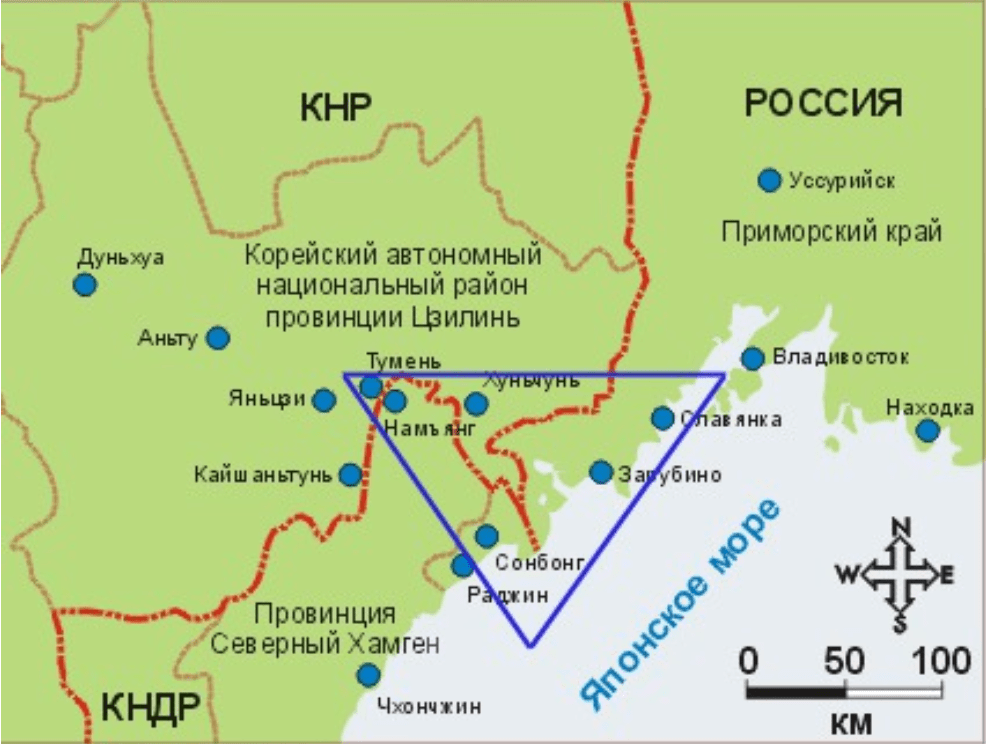
Pic. 1. Map of the Tumangan project
Since Russia and the DPRK did not agree to allocate their sections of territory for the construction of an international trade port, the interested parties came to the conclusion that it was possible to independently and at their own expense develop their sections of territory in the lower reaches of the Tumannaya River [5, p. 3]. As a result, the Chinese sector of the Tumangan project, with the city of Hunchun as its center, began to develop most quickly. At the same time, the Chinese authorities began to look for the access to the sea for their section of the Tumangan project, and also announced the need to organize regular flights between the city of Yanji and Primorye city of Artyom.
After the earthquake and tsunami of March 11, 2011, Japanese business also began to consider the southern ports of Primorye as a promising opportunity to expand trade with the northeastern provinces of China. Moreover, after the tsunami, the infrastructure of ports on the eastern coast of the Japanese archipelago was significantly damaged. In addition, due to the shutdown of Japanese nuclear power plants, there was a long-term shortage of energy supply to enterprises. In this regard, the Japanese authorities began to stimulate the development of ports on the west coast and encourage investments by Japanese companies in Northeast China so that goods and food produced there using Japanese technology could be quickly delivered to Japan [6, pp. 97-99]. Therefore, Japanese business turned its attention to the Primorye ports of Russia, which were already used by Chinese entrepreneurs to export their goods to the Republic of Korea.
In August 2011, as a result of active support of the authorities of Jilin Province and Niigata Prefecture, a ferry service was launched between the ports of Zarubino and Niigata, which reduced the distance by 500 miles compared to trade via the Chinese port of Dalian. This route also had a price advantage in transport logistics, including fast delivery and safety of transported goods. Thus, the port of Zarubino has become a transit point for trade between China’s Jilin Province and Japan’s Niigata Prefecture [7, p. 97, 120].
Subsequently, the authorities of Jilin Province repeatedly declared their intention to “maximize the geographical and infrastructural advantages” of the Chinese sector of the Tumangan project, planning to create a transit base there for the trade of oil, gas, and chemical products and gradually expanding the scale of logistics for these goods [6, p. 122-123]. In 2018, Hunchun was connected by high-speed railway to China’s central highways. As a result, the Chinese free economic zone in the vicinity of Hunchun gained access to three sea ports (Zarubino, Rajin and Dalian) and became known as the “Hunchun Sea Port”. Although the expansion of the infrastructure of the Chinese section of the Tumangan project allowed China to strengthen its transport positions and put forward new initiatives on their basis, attracting neighboring countries to participate, access to the sea through foreign territory did not seem reliable, since it remained dependent on the nature of political relations with neighboring countries.
In addition, the COVID-19 pandemic had a negative impact on the further development of Chinese plans to transport goods through the ports of Russian Primorye. This was due to the fact that in the period 2020-2022, the COVID-19 pandemic forced the Primorye authorities to restrict access of foreign ships to their ports. At the same time, Chinese freight carriers, under the influence of these restrictions and the growth of freight rates for sea transport, reoriented their container cargo to the Russian Trans-Siberian Railway. In this regard, Russian experts came to the conclusion that the COVID-19 pandemic “had a positive impact on container transportation by rail” [8, p. 153]. This conclusion also applies to trade and economic relations between China and the DPRK, since in 2020-2022 all cargo was transported by rail rather than through sea ports.
New Chinese initiatives
Despite all the ingenuity of the Chinese side, further economic development of the Chinese sector of the Tumangan project is hampered by the inertia of Russia and the DPRK and their reluctance to take the initiative and invest capital in the development of their territory adjacent to the lower reaches of the Tumannaya river. In this regard, the Chinese authorities are making qualitatively new efforts to revive the original goal of the Tumangan project. Believing that if other participants refuse direct investment, then the development of cross-border tourism and public diplomacy, which do not require significant capital investment, will be able to move the process forward. For this reason, the Chinese authorities have put forward a new initiative to expand border tourism and create recreational zones in the area where the borders of three states – Russia, China and the DPRK – meet. On the Chinese territory of this section of the border (the city of Hunchun and its environs, the village of Fangchuan), tourist recreation areas and ethnographic villages were created, where foreign guests could get acquainted with the culture and culinary features of Chinese and Korean cuisine. Tourists have the opportunity to take a boat trip and go fishing on the Chinese bank of the river Tumannaya, visit the place where the borders of three states converge and view the border territories of Russia and the DPRK from the seven-story Dragon and Tiger pavilion. Every year, this place is visited by 30 thousand Chinese tourists [7, p. 203].
Currently, the Chinese section of the Tumangan project is being developed within the administrative boundaries of the Jilin Province Korean National Autonomous Region. In this regard, the Chinese local authorities are actively using the geographical and ethnographic features, as well as the historical past of the Tumannaya River region, to attract foreign tourists who would learn that since the mid-19th century, this Chinese territory has been inhabited and economically developed by the descendants of Korean migrants [9, pp. 102-105]. By constantly emphasizing the fact that Chinese Koreans live in this territory, local Chinese authorities have successfully sought to increase the flow of South Korean tourists and investment in the area. Moreover, in order to increase the number of South Korean tourists, Chinese travel agencies have developed special tourist routes for climbing Mount Paektu, viewing North Korean villages on the other side of the Tumannaya river, visits to places of residence of famous figures of the anti-Japanese partisan movement, etc. [7, p. 203].
In order to expand cross-border tourism and trade and economic exchange, the Jilin Province authorities, together with the UN Development Program, annually hold forums devoted to the development of trade and tourism in NEA. If in the early 2010s they discussed a program for creating a transport network in the territory of the Chinese sector of the Tumangan project, then since the late 2010s the Jilin Province authorities started to consider the possibility of more active use of the infrastructure of neighboring countries. Thus, plans began to be discussed in China to expand border humanitarian ties, build bridges across the Tumannaya River, and even construct a canal from the city of Hunchun through Russian territory to Posyet Bay. This would turn the city of Hunchun into a real seaport [10, p. 112].
In September 2019, the 8th Tourism Forum was held in Hunchun within the framework of the Tumangan project, during which the development of sea tourism and the creation of the tourist belt of the Sea of Japan were discussed. About 500 representatives of travel agencies and Chinese local administration, as well as scholars from academic organizations of the NEA countries, took part in the Forum. Participants held in-depth discussions on ways to expand humanitarian cooperation, create a tourism community in Northeast Asia, connect tourism routes along the western coast of the Sea of Japan, strengthen multidisciplinary exchanges and promote the sustainable development of marine tourism, which, in their opinion, has good prospects. The Forum participants were given the opportunity to visit the convergence point of the borders of the three countries and view the bridges across the Tumannaya River.
The speeches of Chinese experts and local government officials emphasized the importance of developing marine tourism in the Sea of Japan. In their opinion, the 2020 Summer Olympic Games in Tokyo and the 2020 Winter Olympic Games in Beijing could become an incentive for the development of this tourism [11]. It was expected that maritime transport and already tested sea routes would be attractive to foreign tourists heading to the Olympic Games. It was assumed that the development of marine tourism in Northeast Asia would create a mechanism for protecting the ecology of the Sea of Japan and would contribute to the economic development of coastal sea areas and ports. However, this was hampered by the COVID-19 pandemic, due to which the Olympic Games were postponed to 2021-2022. Nevertheless, Chinese local authorities do not give up and expect that after the end of the pandemic their tourism projects will receive further development.
The Shanghai-Vladivostok-Maizuru route is especially popular with Chinese tourists, allowing them to visit Russian and Japanese ports. Another popular tour is a cruise from China via South Korean ports to Russia – Shenyang-Dalian-Incheon-Sokcho-Vladivostok. Both routes connect the ports of the NEA countries and use their unique geographical advantages, allowing them to form a tourist ring and create a modern tourist market. At the same time, Chinese experts emphasize that Chinese tourists are generous people and spend significant amounts of money abroad. Thus, according to their calculations, during the period 2008-2019, Chinese tourists left $190 billion abroad, which is very beneficial for the countries that host them [7, p. 205].
The emphasis on developing eco-tourism in NEA is in line with the campaign to create an ecological civilization, which was discussed during the visit of Chinese President Xi Jinping to the northeastern provinces in September 2018. At that time, Xi Jinping voiced the idea of the need to deepen the integration of the Tumangan project with China’s Belt and Road Initiative [11]. The result should be an ecologically attractive and economically developed region in the Tumannaya River Delta. As part of Xi Jinping’s instructions, local authorities in Hunchun have developed plans to preserve the environment and develop cross-border tourism, as well as to attract foreign tourists to the region’s landmarks.
Involvement of the DPRK in the tourism business
Along with organizing sea cruises, the Chinese authorities are developing river tourism, using the border river Tumannaya as a tourist attraction. Thus, the authorities of the city of Hunchun invested 3 million yuan in the creation of a Chinese-North Korean tourist zone. Two bridges were built between the Chinese village of Fangchuan and the North Korean bank of the river – automobile and pedestrian ones, customs border crossing points were organized, and a pier for small vessels was built.
Since May 15, 2019, the Chinese Hunchun-Fangchuan international tourism company together with the North Korean Tumangang travel agency began to organise tourist trips of Chinese citizens to the DPRK. Tourists travel from the Chinese side of the river to the Korean side, visit the historical Russian-North Korean railway bridge, and then go to Lake Pampu (DPRK).
The Chinese Hunchun-Fangchuan international tourism company plans to extend the route to the North Korean port of Wonsan and include a visit to the Kumgangsan Mountains. It is possible that in the future this tourist route will also extend to the south of Primorsky region. To do this, it is necessary to establish close contacts between the travel agencies of the three bordering countries. In the future, the Chinese side intends to create the Tumen River Delta International Tourism Cooperation Zone, which should become an integral part of another Chinese economic initiative, One Belt One Road [7, p. 207].
It should be noted that the DPRK authorities are sympathetic to China’s efforts to penetrate the coast of the Sea of Japan and build a tourist complex in the lower reaches of the Tumannaya River. Participation in this project brings foreign investment and foreign currency income to the DPRK. It is possible that when the COVID-19 pandemic passes, the DPRK authorities will agree to expand the tourist zone to the Rajin-Sonbong FEZ in order to attract additional Chinese investment. In the future, this may lead to the creation of a Chinese enclave in the northeast of the DPRK, which the North Korean authorities previously feared. However, in the context of strengthening anti-North Korean economic sanctions and the need to obtain foreign currency, the DPRK authorities stopped remembering their former fears.
Thus, the administrations of Jilin Province and, in particular, the city of Hunchun are actively working on the strategy of economic development of their territory and are striving to expand the use of transport and tourist facilities of neighboring countries. This allows the northeastern provinces of China (Jilin and Heilongjiang), which do not have direct access to the sea, to actively use the infrastructure of seaports of neighboring countries and expand their economic ties.
***
As can be seen, in the 1990s, the Tumangan project played an important role in increasing the attention of the leaderships of NEA countries to the possibility of joint development of the lower reaches of the Tumannaya river. At the present stage, the Chinese authorities are using the Tumangan project as a tool in their own interests, primarily for establishing cross-border socio-economic ties. Taking into account China’s special interest in developing the Northern Sea Route, it can be assumed that one of the ports in the Sea of Japan can become a base for the Chinese icebreaker fleet. In the future, and subject to close cooperation with another Chinese economic initiative, One Belt One Road, China will be able to expand its economic presence throughout Northeast Asia.
Jilin Province’s leadership quickly adapted to the changed reality of cross-border cooperation, effectively utilizing the advantages of the favorable ecological environment, unique geographical location and ethnic identity of their region in the tourism industry. They have adopted a new approach that views the problem from the perspective of China’s border region inhabited by ethnic Koreans, and actively mobilize transnational ties of Chinese Koreans for the economic prosperity of the Jilin Province Korean National Autonomous Region.
After the 2011 tsunami, Japan was forced to pay attention to the transport capabilities of Primorye seaports due to extraordinary circumstances. At the same time, Japanese business, like South Korean business, has not yet declared its desire to take direct part in the implementation of the Tumangan project program, but has only used the port in Primorye to transport its goods to/from Northeast China. However, due to the COVID-19 pandemic in 2020-2022, this transport route was temporarily suspended.
Russian Primorye is a transit zone for its neighbors. Deep integration processes have not yet affected this region due to the lack of both interested administrative bodies and financial resources. The inertia of Russian local authorities is also affected by the sparse population of the south of Primorsky region. In addition, the lack of air and rail links between Primorsky Artyom with Chinese Hunchun and North Korean Rajin does not allow Russian businesses to actively participate in regional trade and economic ties and the tourism industry. Nevertheless, during the COVID-19 pandemic, Russian railways have proven their efficiency and advantages in comparison with sea transport.
The above allows us to conclude that the incomparable level of socio-economic development and, most importantly, the different socio-political structure and hostile ideologies of the countries participating in the Tumangan project did not allow this project to be fully implemented. It remains to be recognized that in NEA the most realistic and practically justified form of interaction remains bilateral cooperation, which was manifested in the Chinese-North Korean cooperation within the framework of the Tumangan project. Apparently, the Chinese authorities, interested in continuing the economic development of the lower reaches of the Tumannaya River, will have to adapt to the interests of other NEA countries and conclude separate agreements with them on the terms of investment or other participation in the implementation of this international project. This method of solving the problem is complex and multi-stage, but there is no other way. As a result, the dream of creating a Hong Kong-like city in the lower reaches of the Tumannaya River remains unrealistic for now.
It is noteworthy that the Chinese authorities understand that the potential of the Tumangan project as an effective tool for cross-border cooperation is very limited. For this reason, China will have to constantly review its tactics in interaction with the NEA countries. Taking this circumstance into account, the Chinese authorities did not set the goal of simultaneously overcoming the entire complex of political and economic problems. They are moving towards the implementation of their own objectives of the Tumangan project in small steps, focusing their efforts on the implementation of easier and less capital-intensive measures first, and only then moving on to overcome more difficult tasks. This tactics and strategy, typical of Chinese thinking, reflects the Confucian principle of “reaching agreement when there is disagreement.” In connection with this approach, it can be assumed that the tasks of the Tumangan project will gradually be completed and the landlocked provinces of China’s Northeast will gain reliable access to the ports of the Sea of Japan.
REFERENCES
1. Report on the Development Study in the Tumen River Area, New York: UNDP, 1991,115 p.
2. DPRK-PRC-Russia: Promising “Tumangan Project” Remains an Unfulfilled Dream, Kompas (ITAR-TASS), 1995, no. 190, pp. 28-3 / КНДР-КНР-Россия: многообещающий «Туманганский проект» остается невыполненной мечтой. Компас (ИТАР-ТАСС), 1995, № 190, cc. 28-31
3. Kortunov I.N. About the Project of the Free Economic Zone “Tumenjiang” in Russia, China and the DPRK, Problems of the Far East, 1994, No. 3. pp. 14-18 / Кортунов И.Н. О проекте свободной экономической зоны «Тумэньцзян» на территории России, Китая и КНДР, Проблемы Дальнего Востока, 1994, № 3, cc. 14-18
4. Zabrovskaya L.V. Russia and the Republic of Korea: from Confrontation to Cooperation (1970-1990s).]. Vladivostok: IHAEFE RAN, 1996. 128 p. /Забровская Л. В. Россия и Республика Корея: от конфронтации к сотрудничеству (1970-1990-е гг.) Владивосток: ИИАЭ ДВО РАН, 1996. 128 с.
5. Kazakov I. Vague Prospects of the Tumen River]. Kommersant, 1995, № 40, p. 3 / Казаков И. Туманные перспективы реки Туманной. Коммерсантъ. 1995. № 40. с. 3.
6. China. Tumen River Basin Border Area Regional Cooperation and Modern Logistics Forum. Compilation of Speech. Changchun: Economic and Technological Cooperation Department of Jilin province, 2011. 124 p.
7. Introduction of Cross-River Tour of Tumen River. The 8th Great Tumen Initiative NEA Tourism Forum. Conference Materials. Hunchun. 2019. Рр. 203-208.
8. Prokapalo O.M., Bardal A.B., Mazitova M.G., Suslov D.V. Economic Situation in the Far Eastern Federal District in 2021. Prostranstvennaya Ekonomika = Spatial Economics, 2022, vol. 18. №2. pp. 135-182, URL: https://dx.doi.org/10.14530/se.2022.2.135-182 /Прокапало О.М., Бардуль А.Б., Мазитова М.Г., Суслов Д.В. Экономическая конъюнктура в Дальневосточном федеральном округе в 2021 г. «Пространственная экономика», 2022, т 18, № 2, сс. 135-182
9. Park Alyssa M. Sovereignty Experiments: Korean Migrants and Building of Borders in Northeast Asia, 1860-1945, Ithaca; L.: Cornell Univ. Press, 2019. XVIII, 284 p. Park, 2019
10. The 7th Summit Forum on the Northeast Asian Cooperation. Changchun: International Conference Center of the prov. Jilin, 2013. 126 p.
11.张雪楠. 发展海洋旅游 构建环海旅游经济带. “大图们倡议”第八届东北亚旅游论坛在珲举行. [Zhang Xuenan. Development of the Sea Tourism. Creation of a Sea Tourist Belt. The 8th NEA Tourism Forum held in Hunchun (in Chinese)
 marinejournal.info