
THE PORT CITY OF VLADIVOSTOK: PROBLEMS AND PROSPECTS FOR SPATIAL DEVELOPMENT
Sergei M. Smirnov
Admiral Nevelskoy Maritime State University, Vladivostok
Abstract: The port city of Vladivostok is a unique phenomenon. Its role, significance and degree of impact on the development of the Russian Far East and the neighboring states of Northeast Asia cannot be underestimated, considering separately the aspects of a military – strategic or transport – economic nature. The period of Vladivostok’s evolution, short by historical standards, passed through several fundamental key moments each of which could change the direction of the development paths not only of Primorye and the Far East, but of the country as a whole. Vladivostok received its most recent powerful impetus for development in 2011–2012 in preparation for the APEC Summit. By the beginning of the 2020s, this positive influence had practically exhausted itself. To understand the prospects for the spatial development of Greater Vladivostok and its transport and logistics hub, the article provides a cross-disciplinary analysis of trends, internal and external factors, the intersection and overlap of interests of the state, business, public institutions and the city population within the city historical borders, new territories included in agglomeration, and a multimodal transport hub based on the seaport.
Keywords: Vladivostok, transport and logistics hub, spatial development, agglomeration, urban settlement, naval port city, intra- city communications
The port city of Vladivostok was founded in 1860 as a naval post, and very quickly by historical standards, turned into the eastern outpost of the Russian Empire, a fortress city, and the main center of Russian international trade on the Pacific Ocean. [1]
There were several key moments in the history of Vladivostok, a kind of forks in the road which in a different situation could have changed the main direction of the development paths not only of Primorye and the Far East, but, possibly, of the country as a whole. During the 1904-1905 Russo-Japanese War, the existence of the Vladivostok naval fortress prevented the spread of hostilities to Russian territory, while convincingly demonstrating the adventurism
of domestic colonial expansion into northern China. In both world wars of the 20th century, a huge amount of military and humanitarian cargo passed through the port of Vladivostok and the Trans-Siberian Railway (TSR), which made it possible to withstand the most difficult moments of the war in the European theater. The “opening” of the city to foreigners in 1991 became a landmark event that contributed to the restructuring of the entire socio-economic structure in the Far East. Vladivostok, already in the format of a de facto agglomeration [2] received its last powerful impetus for development in 2011–2012, in preparation for the APEC Summit.
As happened with many other successful port cities around the world, at a certain stage of development the interests of the “City” began to diverge from the priorities of the “Port”. The port’s activities, noisy, energy-intensive and not always environmentally friendly, began to be perceived as a burden for citizens and an obstacle to harmonious urban development. Similar processes occur with other modes of transport. Thus, airports that were previously located far outside urban settlements, according to the laws of spatial development (flat terrain, availability of road and energy infrastructure), “attracted” urban areas whose residents today demand a ban on night flights, noise reduction, and other restrictions. Railway lines passing through urban areas create obstacles to road traffic, and
so on.Today, the Vladivostok Transport and Logistics Hub (VTLH) is facing the challenge associated with the need to radically increase throughput capacity in connection with the reorientation of Russia’s main cargo flows from the western to the eastern direction in the face of increasing sanctions pressure. In fact, the scale of the task is not inferior to that of the Second World War. The only difference is that the USSR had a mobilization command-planned economy in 1941 – 1945, and today problems have to be solved in a multi-structured market environment and the restrictions of the international monetary and financial system, which cannot be solved by administrative means.
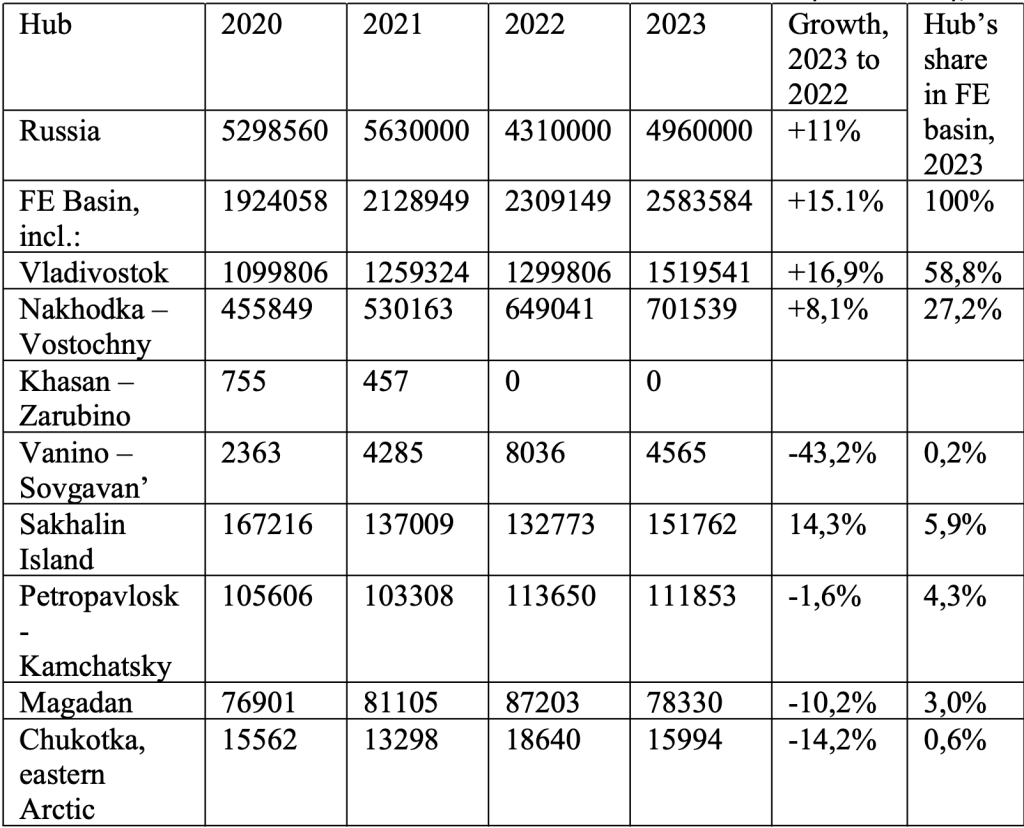
Of course, VTLH is not the only one major transport hub in the Far East of Russia. The seaports of Nakhodka – Vostochny, Vanino – Sovetskaya Gavan hubs play an important role, as well as less successful, but with good prospects ports in the south of Primorye – Posiet, Zarubino, Slavyanka. However, the position of Vladivostok is unique (Table 1). It just so happens that the success or failure of
Vladivostok will be perceived as a corresponding assessment of the success of the entire Russian Far East. Why – more on this later.
Table 1. Container turnover in the ports of Russia and Far Eastern basin (2020-2023), TEU
VTLH and the urban settlement of Vladivostok
The geographic location of Vladivostok on the narrow and mountainous Muravyov-Amursky Peninsula determines the presence of objective restrictions on its spatial development. The main part of the port facilities is located in the narrow and navigationally complicated Golden Horn Bay, while only part of the berth line is accessible for ships with deep draft. The bays on the coast of the Ussuri Bay and in the Eastern Bosphorus Strait for a number of reasons are used on a limited scale for servicing civilian vessels. The adjacent coast of the Amursky Bay is shallow and, after the construction of the low – water Sedanka – De Vries Bridge, cannot be considered as a potential area for port development. Without expanding the coastline through filling, the hinterland of the seaport of Vladivostok has no development reserves, and the same applies to the potential for the development of railway approaches to the port.
In turn, the city of Vladivostok within its administrative boundaries has also exhausted the potential for extensive growth. The current practice of infill development in existing city blocks, lobbied by large federal developers, faces insufficient capacity of utility networks, causes dissatisfaction among residents, and distorts the architectural appearance of the city. Massive development of new urban areas (Patroclus, Green Corner, Snegovaya Pad’) leads to overload of urban energy grid and water treatment facilities. At the same time, it destroys forest areas worsening the environmental situation in the city, which is already experiencing an acute shortage of green space.
However, the insufficient capacity of intra-city communications connecting the seaport terminals with TSR junction stations and the A-370 “Ussuri” federal highway is the main problem and obstacle to the development of both the city and port. These lines of communication (both road and rail) pass through historical areas of the city, where the potential for their physical expansion is seriously limited. A number of road infrastructure facilities are in critical condition in terms of wear and tear and can collapse at any time, blocking traffic on the most important routes. The infill development of the city, especially in the area of Egersheld and Second River, combined with the growth of the fleet of personal vehicles aggravates the situation on public roads.
In preparation for the APEC Summit – 2012 in Vladivostok several large projects in the field of transport infrastructure were implemented. Three of them, the bridge across the Golden Horn Bay, the Sedanka – De Vries low – water bridge and the reconstruction of the A-370 highway can be considered extremely successful. The fourth project, Sedanka – Patroclus bypass road had major shortcomings on the part of both design and implementation, however, it also contributed to the unloading of urban transport communications. The fifth and most expensive project, a bridge on the Russky Island, today is used at no more than 20% of its capacity, but it can well be considered a strategic investment in the future.
Elementary calculations show that in the absence of the above infrastructure projects the urban settlement of Vladivostok by today would find itself in a situation of permanent transport crisis, and VTLH would definitely not be able to cope with new challenges after February 2022. However, by the beginning of the 2020s this positive development impulse has exhausted itself.
The measures taken today by city authorities to relieve traffic within the city are inconsistent and half – hearted. In particular, instead of a complete ban on parking outside specially formed pockets along the main city highways, paid parking zones were established, which bring in insignificant income to the city budget but do not solve the main problem. The introduction of dedicated lanes for public transport on a number of road sections and some other decisions have lengthened the intra-city routes permitted for freight vehicles going to / from the port and almost eliminated parking spaces for them within the city, which increases emissions into the atmosphere and disrupts the rhythm of operation of seaport terminals.
The list of problems and bottlenecks, as well as criticism of the decisions / inaction of both city authorities and VTLH actors (stevedoring, transport and logistics companies, RZhD, etc.) can be continued almost indefinitely. However, it would be preferable to consider alternative options for getting out of the current difficult situation.
Prospects for the development and coexistence of the city and the port
Philosophically, we can talk about two approaches to assessing the current state, forecasting and accordingly, planning the development of a port city.
The first one, let us call it “Western” or “Pragmatic” approach, implies the priority of economic feasibility. A historical and economic analysis of the strategic role and economic contribution of the industry associated with the seaport in the general budget of the urban settlement, forecasting the volumes and routes of cargo flows through the port, existing and promising sources of investment are used for analysis. In parallel, the problems and prospects for the urban development, demographic and social trends among the population (residents and labor migrants) should be assessed. Finally, strategies, concepts, master plans, roadmaps etc. are produced, often with the involvement of external consultants who do not have established connections and involvement in the local environment, which has both positive and negative effects.
Despite the formal objectivity of the process, which relies on statistical data and operates with financial and economic indicators, it will not be possible to avoid the influence of non-economic factors. First of all, political considerations (varying at the federal, regional and community levels), contradictions within business elites, and a changing external situation.
The “Western” approach encourages the adoption of quick and simple decisions based on the “cost – effectiveness” criterion. It is quite possible that at some point, the “urbanists” may prevail and the process of curtailing port activities in Vladivostok will begin. Less likely (but not impossible) is the opposite option when priority will be given to investment, land allocation and resource distribution in favor of VTLH. Naturally, the cost of an error in such a decision in any case will be very high and most likely, irreversible.
(End of introductory fragment)
 marinejournal.info