
THE 1998 RUSSIAN-JAPANESE AGREEMENT: AN OLD LEGACY THAT MUST BE DISCARDED
Vyacheslav K. Zilanov
Honorary Doctor in Murmansk Arctic University (Russia),
professor, honored specialist of Russian fishing industry, Murmansk, Russia
Alexei Yu. Plotnikov
Doctor of Historical Sciences, professor in Moscow State
Linguistic University, Moscow, Russia
Abstract: The article analyzes the 1998 Russian-Japanese Agreement on Cooperation in the Field of Marine Bioresource Harvesting in the Southern Kuril Islands. Based on their analysis, the authors concluded that this Agreement is detrimental to Russia’s economic and political interests and rights in this area.
The Agreement was concluded during a difficult period for Russia in the 1990s, when the country was weak and unable to fully protect its sovereignty. Now, given the current global situation, the time has come to revise or repeal the 1998 Agreement.
Keywords: Far East, Kuril Islands, Japanese territorial claims, Yeltsin, fisheries, territorial waters, toponymy
Japan’s territorial claims to Russian southern Kuril Islands are the cornerstone of Japanese foreign policy, both in the past vis-à-vis the Soviet Union and now in vis-à-vis the Russian Federation.
Throughout the post-war period, particularly since the mid-1990s, this issue has remained a major problem in bilateral relations. Even now, when bilateral relations have been reduced to near zero due to the New Cold War and the Japanese government’s openly hostile policy toward Russia, which has proven itself to be the United States’ loyal “unsinkable aircraft carrier,” Tokyo constantly asserts the need to conclude a peace treaty conditioned on the satisfaction of its territorial claims to the southern Kuril archipelago, including the islands of the Lesser Kuril Chain. As repeatedly stated by Russian official representatives [1], such a “peace treaty” has ultimately lost all meaning today.
One of the currently valid documents that encourages and fuels such Japanese claims is the “Agreement between the Government of the Russian Federation and the Government of Japan on Certain Issues of Cooperation in the Field of Marine Exploitation” of February 21, 1998 (hereinafter referred to as the 1998 Agreement). [2]
The 1998 Agreement was concluded on the personal instructions of then-President of Russia Boris Yeltsin. The 1998 Agreement was developed over three years. During this time, thirteen rounds of negotiations took place alternately in Japan and Moscow.
The area of application of the 1998 Agreement is the Russian territorial sea (territorial waters) off the islands of Iturup, Kunashir, Shikotan, and the Lesser Kuril Islands. The details will be explained below.
The South Kuril Straits – the keys to Russia’s Far East
First, we would like to draw attention to several frequently overlooked issues directly related to the 1998 Agreement.
First and foremost, it is the overall importance of the Kuril Archipelago, the adjacent 200-mile exclusive economic zone (EEZ), and the South Kuril Straits for navigation and security in the Russian Far East.
The Russian EEZ in the Kuril Archipelago area is known to be very rich in marine resources and is an important fishing area for Russia. These areas, particularly the Pacific Ocean section adjacent to the southern Kuril Islands, have always attracted the attention of Japanese fishermen, who, often in open violation of Russian fishing laws and regulations, have poached saury (samma), salmon, pollock, crabs, squid, octopus, sea urchins, seaweed, and other species. At the same time, Japanese authorities continually sought to legitimize their poaching activities off the Southern Kuril Islands by trying to conclude agreements with Russia that, at least indirectly, confirmed their claims to the maritime space around these islands, and therefore to the islands themselves. They largely succeeded in achieving this by concluding the aforementioned 1998 Agreement.
It should also be noted that the South Kuril Straits, particularly the Friza and Yekaterina Straits, are ice-free compared to the northern straits of the Kuril Archipelago, and are deep-water, which is important for the passage of both surface ships and submarines. These straits are essentially the keys to the entire Russian Far East.
Nevertheless, during Boris Yeltsin’s tenure as President of Russia, his diplomatic aides negotiated the unprecedented 1998 Agreement, which allowed the Japanese not only to fish for marine resources there but also to control the South Kuril Straits.
Under this agreement, for the first time in Russian practice Japanese nationals were granted the rights to fish in Russian territorial waters around the southern Kuril Islands, including the waters of the Lesser Kuril Islands. These are the largest islands of the Kuril Archipelago by area, the most populated, and possessing significant reserves of marine bio and mineral resources, including oil and gas reserves on the islands’ continental shelf.
Essentially, this agreement grants the Japanese “extraterritoriality” rights in a certain area of Russian territorial waters. This is not an empty assertion. It follows directly from the text of the 1998 Agreement.
In this regard, let us examine this document in more detail.
On “fishing diplomacy” that outsmarted itself
Fist, it should be noted that within the general legal framework of Soviet/Russian-Japanese fisheries interaction, the 1998 Agreement marks the second time that Japanese fishing vessels have been permitted to fish in Russian territorial waters off the southern Kuril Islands, including the Lesser Kuril Islands, which, as noted above, Japan continues to claim.
The first such agreement regarding seaweed fishing by Japanese fishermen near Signalny Island (Japanese name “Kaigara“) was concluded back in 1963. This agreement was subsequently renewed with minor amendments in 1981. It remains in force today. However, there are also fundamental differences between the 1998 Agreement and the 1963/1981 Agreements, which will be discussed below.
The 1998 Agreement was signed on February 21 and entered into force on May 21 of that same year, through an exchange of notes, bypassing the ratification process. The Agreement itself contains only seven articles and is five pages long, including one page of Appendix.
There is a special Memorandum containing the explanatory portion for this agreement. This document, which until recently served as the basis for specific annual so-called “cooperation” between the parties, together with accompanying clarifications, contains over 35 pages of densely packed text at present.
The Fig. 1 shows the annual fishing areas in accordance with the said Appendix and the Memorandum of Understanding.
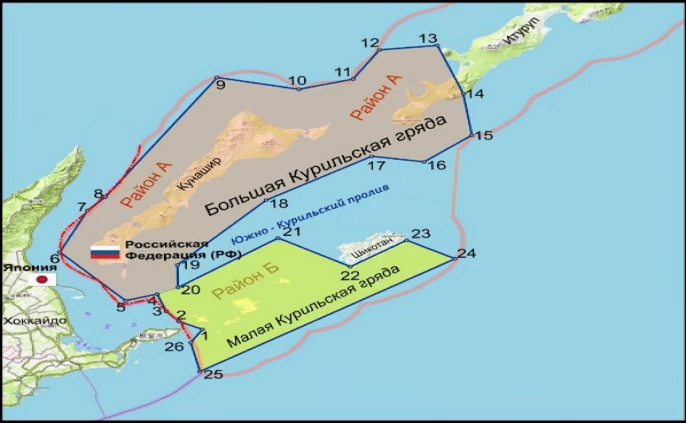
Fig. 1. Map-scheme of the marine area of harvesting bio resources by Japanese fishing vessels in the Russian territorial waters of the southern Kuril Islands and the Lesser Kuril Ridge under the 1998 Agreement. ©A.V. Brazhnik, PhD, Geological and Mineralogical Sciences.
The red line is the state border of the Russian Federation.
The yellow line is the boundary of the territorial waters of the Russian Federation;
The blue line with numbers is the boundary of the sea area in which Japanese vessels are fishing for marine bio resources.
Area A – pink shading – pollock and Atka mackerel gillnet fisheries.
Area B – pale green shading – octopus hook and line fisheries.
The maritime area bounded by the points specified in the Appendix to the 1998 Agreement has a perimeter of 418 nautical miles (775 km) and an area of 5,258 square miles (13,619.35 km2).
It includes not only the waters but also the entirety of Kunashir Island and the Lesser Kuril Islands, and part of Iturup Island up to a line from point 13, approximately 2 km northwest of Cape Bolshoy Nos. The entire area lies within the Russian EEZ and includes the territorial waters around all of the listed islands: Kunashir, Iturup, and the Lesser Kuril Islands. In many cases, the breakpoints of the maritime area’s boundary coincide with the breakpoints of the territorial waters, which convincingly demonstrates that the boundaries of the maritime area were defined in such a way as to specifically include the territorial waters of the Russian Federation.
Moreover, the aforementioned maritime area in some cases also includes the internal waters of these islands, such as Lion’s Mouth Bay on Iturup Island. In these waters, the coastal state has sovereign rights to all activities, including the harvesting and exploitation of marine fisheries resources.
The first thing that strikes one upon reading the text of the 1998 Agreement is the obvious discrepancy between its title and its content. The fact is that it does not address cooperation issues at all, but rather the granting of commercial rights to Japanese fishermen to exploit marine bio resources in Russian territorial waters off the southern Kuril Islands.
For this reason, the 1998 Agreement should have been titled not “On cooperation,” which, we emphasize, does not exist, but “On the harvesting of fish products by Japanese fishermen in the area of the southern islands of the Kuril Archipelago.”
However, this is only the first “mere trifle” compared to what is contained in the text of the 1998 Agreement itself, the aforementioned Memorandum, the Guidelines for the Conduct of the Fishery and a number of accompanying diplomatic notes.
All states jealously protect their rights in territorial waters, denying access to foreign fishermen even to the use of military force. Russia has acted in this manner along the entire perimeter of its maritime borders – from the Baltic and Barents Seas, the White Sea, to the Sea of Okhotsk and the Bering Sea, from the Black Sea to the Caspian Sea. Examples of defending our fishing rights against Japanese poachers with weapons and in territorial waters around the southern Kuril Islands are still fresh in our memory. [3]
However, according to the 1998 Agreement currently in effect, the Russian Federation effectively renounces its fishing rights in its territorial waters around the southern Kuril Islands. This follows directly from the text of the Agreement, where the very first article states that “the parties shall cooperate for the purpose of carrying out the harvesting of marine bio resources by Japanese fishing vessels in the sea area… off the islands of Iturup, Kunashir, Shikotan, and Habomai (the Japanese name for the islands of the Lesser Kuril Chain – authors).
It follows that we are “cooperating” with a foreign state conducting a fishery in our territorial waters (i.e., we repeat, on our territory), rather than permitting it to conduct this harvesting.
Moreover, the wording of Articles 1 and 2 also implies that Japanese fishermen will be fishing not in Russian territorial waters—which should have been clearly stated in the agreement—but in some “nameless,” unowned “maritime area,” whose nationality is not mentioned.
Mr. V.I. Saplin, Deputy Director of the Department of the Russian Ministry of Foreign Affairs who headed the Russian delegation at the final stage of negotiations, acknowledges that “the text of the framework agreement signed in February contains some vague wording. This is due to the need to consider the specific nature of this issue. The positions of the parties differ, and to make something possible, it was necessary in some places to avoid direct, categorical language, which might be adopted in similar agreements with other countries“. [4]
We draw attention to the words “maybe” and “in similar agreements.” It was precisely this “element of somewhat vague wording” that led to a critical attitude towards the 1998 Agreement by members of the Sakhalin Regional Duma (Parliament), members of the Federal Assembly of Russia, experts, and the general public, particularly in the Far East.
Furthermore, this created certain difficulties in its practical implementation. In particular, it produced a situation when Russian fishermen based in the southern Kuril Islands, including the Lesser Kuril Chain, have been forced out of these fishing areas.
The above are far from all the “diplomatic oddities” concerning the 1998 Agreement.
Japan de facto obtained control over its own fishing in Russian waters
The main document, e.g. the 1998 Agreement itself, makes no mention of monitoring the Japanese fishing vessels by Russian authorities, nor does it mention anything about Japanese fishermen’s compliance with Russian laws and regulations.
Meanwhile, similar agreements from the Soviet period, in particular the aforementioned 1963 and 1981 Agreements on the Seaweed Fishery in the Lesser Kuril Ridge, clearly stated that “Japanese fishermen… engaged in the seaweed fishery… must comply with the laws, regulations, and rules of the Union of Soviet Socialist Republics in force in this area“. [5]
This crucial provision, which had been in effect for over thirty years, disappeared in the text of the 1998 Agreement.
The aforementioned Mr. Saplin insisted in the fishery publications that “the Russian system of border control and fisheries supervision has existed and will continue to exist. It is designed to control Russian fishing participants (note: not Japanese, but Russian, who, according to the “letter” of the Agreement, are merely “fishing participants” in their own territorial waters – Authors). And this Agreement is being “inserted” into this system, as it were.”
A logical question arises: why is this “insert” necessary? Why should any exception be made at all, or, to put it bluntly, unilaterally exempt representatives of a particular foreign state—in this case, Japan—from the control of its own Coast Guard and Fishery protection agencies? Why then not make the same “insert” for Chinese, Korean, American, and other fishermen? How are they any worse than the Japanese?
The text of the 1998 Agreement also makes no mention of penalties for Japanese fishermen for poaching, violating fishing regulations, or violating stock conservation measures. The “Guidelines for the Procedure of Harvesting Marine Living Resources by Japanese Fishing Vessels,” a document previously transmitted to the Japanese side in a separate note from the Russian Ministry of Foreign Affairs, also makes no mention of compliance by Japanese fishermen with Russian fishing regulations or penalties for violating them. The only thing we detected after reviewing the entire stack of “accompanying” documents is that our Ministry of Foreign Affairs, in its note, “brings to the attention” of the Japanese side the Russian laws and regulations in effect in the area. In turn, the Japanese Ministry of Foreign Affairs, in a reply note, promises to “bring” these to the attention of the “Hokkaido Fisheries and Concerned Fishermen’s Association“, i.e. a non-government organization.
In other words, Japan as a state assumes no formal obligations on this key issue.
As a result of such diplomatic “exercises», we have a situation where our domestic laws and regulations are merely “disclosed” to Japanese fishermen operating in our territorial waters, rather than being mandated for their unconditional compliance, as required by Russian law and standard international practice in such cases.
In fact, we are dealing with an unprecedented case, and this deserves special emphasis: granting foreign citizens “extraterritorial status” in our territorial waters—that is, their non-subordination to the laws of the Russian Federation in its territorial sea—a status that is “colonialist”, discriminatory, and unacceptable in relations between states from the perspective of contemporary international law.
Other “innovations” in the 1998 Agreement are no less humiliating. For example, it only refers to Japanese fishermen, but makes no mention of the principle of reciprocity. Namely, about Japan’s obligation to provide similar rights to Russian fishermen to fish in their territorial waters, as was previously stipulated, for example, in the Soviet-Japanese Fisheries Agreement of 1977.
Even more puzzling is the use of Japanese geographical names, including even the names of island capes, alongside Russian ones in the Memorandum and the “Guidelines for Fishing Procedures.”
It is well known that geographical names are one of the most important elements confirming a state’s sovereignty over its territory, and a self-respecting country would never allow its territory to be designated by other names in an international treaty, even alongside its own. This approach to Russia’s international agreement is a gross violation of the Russian Federation Law “On the Naming of Geographical Objects,” which stipulates that only Russian geographical names be used in official documents. [6]
All these reservations and subterfuges are made to prevent the formulation that “fishing is carried out in the territorial waters of the Russian Federation in accordance with Russian laws and regulations” (as, we repeat, is recorded in the 1963/1981 Agreements), which could be “seditious” for Japan, but the only correct one in this case.
As a result, the Japanese were granted the quota to catch approximately 2,300 tons of fish annually with nearly 50 vessels, paying a total of approximately 45 million yen (23 million rubles at today’s exchange rate). In reality, the Japanese used to catch no more than 1,000-1,300 tons annually, which equates to only about 17.5 rubles per kilogram of caught aquatic bio resources.
It would seem as too expensive price for just 1,300 tons of pollock, greenling, flounder, perch, octopus, and other species.
Indeed, it would be impossible to receive this sum for such a small quantity of fish caught, even if it were sold on the expensive Japanese market.
So, the Japanese sold themselves short, while the Russian initiators of this agreement gained?
Russia gained nothing, since rational Japanese will not overpay for anything. Clearly, the fish are not the primary target here, but merely a cover. Japan is paying for favorable legal language that creates the political and judicial framework it desires, a legal precedent that can later be presented in negotiations (or, if necessary, in an international court) as a fait accompli.
As global practice shows, these will be arguments that are extremely difficult to dispute.
Should the Southern Kuril Islands, including the Lesser Kuril Chain, be ceded to Japan, Russia’s losses of waters, continental shelf and, consequently, areas for domestic marine resource harvesting, would amount to approximately 200,000 square kilometers of its 200-mile EEZ, both on the Pacific and Sea of Okhotsk sides, with all the attendant negative consequences. The loss of annual domestic marine resource catch alone would amount to at least 700,000 tons, with potential growth to approximately 1.5 million tons. Furthermore, these areas contain significant reserves of various mineral resources and hydrocarbons, both on the islands and offshore. For example, oil and gas reserves in this region are estimated at over 396 million tons of standard fuel.
In a hurry to secure such a controversial deal and wanting to prevent its consideration in the Russian parliament, the authors and lobbyists of the 1998 Agreement hastened to notify the Japanese side of its entry into force on May 21, 1998, while “… the administration of B. Yeltsin, bypassing this legal provision, put the agreement into effect through approval by the Government of the Russian Federation”. [7]
In other words, they presented the case as if the 1998 Agreement was a standard intergovernmental document that did not require discussion or ratification by the Federal Assembly of Russia, which contradicts the Constitution of the Russian Federation.
This is despite the fact that, as has been demonstrated, the 1998 Agreement directly affects issues of Russia’s territorial sovereignty and effectively amends current legislation (recall that this effectively excludes foreign citizens operating on our territory from Russian jurisdiction). Furthermore, it also endangers the national security and creates the preconditions for future delineation of the EEZ and continental shelf between Russia and Japan to our disadvantage.
Overall, an analysis of the 1998 Agreement, its Appendix, and corresponding annual MoUs (Memorandum of Understanding on fishery procedures) indicate that they have no significant economic significance for Japan’s fisheries, nor do the resulting fees for the budgets of Russia and the Sakhalin Territory.
The executive and legislative authorities of the Sakhalin Territory have repeatedly proposed terminating the 1998 Agreement so that only fishing vessels flying the Russian Federation flag can fish in our territorial waters off the Southern Kuril Islands.
The last MoU was signed by the parties in December 2021 for the 2022 fishing season. However, it was suspended due to the Japanese side’s delay in paying fees for fishing rights and was subsequently terminated in retaliation for Japanese anti-Russian sanctions.
Negotiations on fishing rights have not been resumed in 2023-2025, despite the Japanese side repeatedly requesting that the Russian side conduct negotiations with the aim of reaching appropriate agreements. A similar situation is developing for the 2026-fishing season. It is clear that these agreements will not be renewed in the near future.
In summary, we should note:
– The 1998 Agreement was concluded during a period of expectations for the rapid progress in bilateral Russian-Japanese relations, which, through no fault of the Russian side, have not materialized.
– Due to Japanese anti-Russian sanctions, the 1998 Agreement has been effectively inoperative for five consequent years. Furthermore, its significance for Japanese fisheries is minimal, as is the fee received by the Russian side for these fisheries.
– Taking into account the above analysis of the provisions of the 1998 Agreement, its Appendix, and the annual MoUs, the fact that the Agreement has been practically unimplemented for several years and its inconsistency with Russia’s national interests, it is advisable to terminate it.
In this regard, it is necessary to proceed from the provisions of paragraph 2 of Article 7 of the aforementioned 1998 Agreement, which provide for a simple mechanism for its termination in such cases, namely, by sending a written notice from the competent Russian authorities to the Japanese side. Further cooperation between Russia and Japan in marine fisheries can be carried out on the basis of existing intergovernmental agreements and MoUs, taking into account the principles of good-neighborliness, mutual benefit, and the rational use and conservation of shared marine resources in the North Pacific and adjacent seas, without any territorial claims.
In accordance with the Constitution of the Russian Federation, the territory of the state is inalienable, and any bargaining over it is inadmissible.
This should be the premise of the future.
REFERENCES
1. In particular, in the Russian MoFA declarations of February 10, 2023 and January 31, 2024.
2. Bulletin of International Treaties. Official publication. No. 2, 1999. – М.: Judicial literature, pp. 53-56.
3. See, for instance URL: https://www.kommersant.ru/doc/86902
4. Saplin, V.I. Fishing by Law // Fisheries, 1998, No. 3, pp. 50-53 / Саплин В.И. Промысел по закону // Рыбное хозяйство 1998. № 3, с. 50-53
5. Cited: The Russian Kuril Islands: History and Modernity. A Collection of Documents on the Formation of the Russo-Japanese and Soviet-Japanese Borders. Third Edition. / Authors-compilers Zilanov, V.K., Koshkin, A.A., Plotnikov, V. Yu., Ponomarev, S.A. –M.: “Algorithm”, 2015, pp. 201-202. Цит. по: Русские Курилы: история и современность. Сборник документов по истории формирования русско-японской и советско-японской границы. Издание третье / Авторы-составители: В.К. Зиланов, А.А.Кошкин, А.Ю.Плотников, С.А.Пономарев. – М.: Алгоритм, 2015, с. 201-202
6.Federal |LawNo. 152 of December 18, 1997 “On the Naming of Geographical Objects”. Articles 8.1, 8.2, 11.
ФЗ №152 от 18.12.1997 «Закон о наименовании географических объектов», статьи 8.1, 8.2, 11.
7. Zilanov, V.K.A change of foreign policy direction and fishing. URL: https://www.fondsk.ru/news/2022/04/09/smena-veh-vo-vneshnej-politike-i-rybolovstvo-55947.html, April 9, 2022. Зиланов В.К.Смена вех во внешней политике и рыболовство.

