
STUDY OF THE CAPACITY FOR GRAIN CARGO FLOWS THROUGH THE PORTS OF THE FAR EAST
Dmitrii S. Kopiev
Admiral Nevelskoy Maritime State University, Vladivostok
Abstract: Subjects of the Russian Federation potentially interested in exporting grain crops through the ports of the Far East have been identified. The description of territories included in the hinterland of the Far Eastern seaports is provided . The foreland boundaries of the ports of the Far East engaged in grain export to Southeast Asia have been clarified.
Keywords: export potential of the territory of the Far East, grain hinterland of the Far Eastern ports, determination of the boundaries of the grain foreland of the Far Eastern ports, sales by direct agreement with importers, transportation of grain in containers
Climate change, which has affected grain yields, demographic and social tendencies in the countries of Southeast Asia, which have increased the consumption of grains, legumes and oilseeds, are making changes in the structure of traditional grain supplies.
New opportunities for Russian exporters are also opened by the departure of Ukrainian grain traders from the North-East and Southeast Asian markets. Bangladesh alone increased purchases of Russian grain by 2.5 times, to 2 million 443 thousand tons against 975 thousand tons last season, another major importer, Pakistan increased imports of Russian wheat by 12%, to 1 million 478 thousand tons .
One of the competitive advantages of Russian grain is undoubtedly the supply price. Thus, the price of Russian class 4 wheat (FOB Novorossiysk) is cheaper by an average of $10-12 per ton relative to EU prices. [1,4]
The conduct of a special military operation by the Russian Federation left its mark on grain trading patterns. Difficulties arose due to the refusal of insurance companies to insure Russian cargo and the ban on making payments through the SWIFT channel, which caused problems in chartering bulk grain carriers. International shipping companies refuse to transport cargo from Russian traders
and enter Russian ports to avoid being subject to secondary sanctions.
New delivery schemes make routes more expensive. This gave rise to sales by direct agreement with importers and opened up opportunities for potential exporters with small volumes of supplies, which include traders from the Far Eastern Federal District. In addition, the eastern direction of grain exports to the Asia-Pacific countries did not arouse interest among large traders due to infrastructural problems of the transport system of the Far East and, above all, a shortage of grain storage capacity and port facilities for transshipment. Large traders currently focus mostly on replacing Western traders who have left the
market.
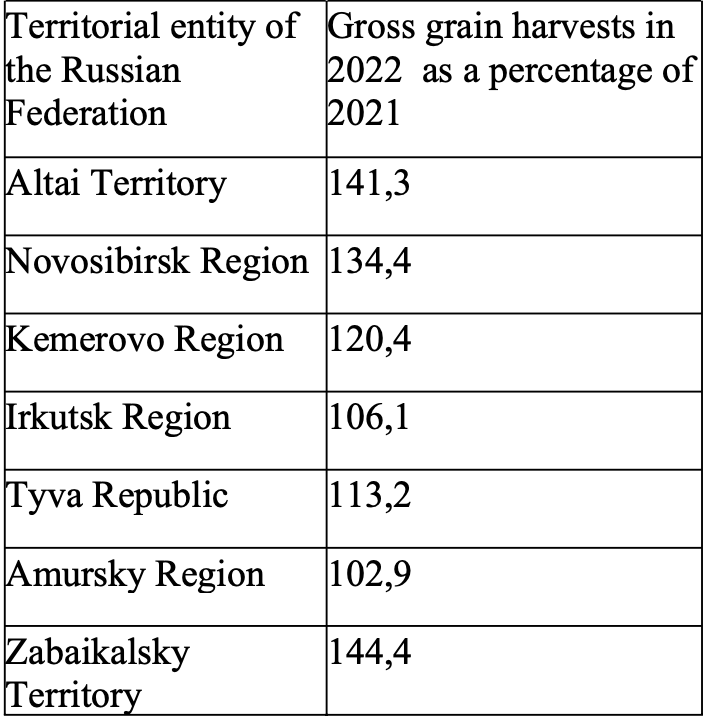
As a result, the ports of the Far East have acquired a grain hinterland from producers in Eastern Siberia and the Far East. The formation of the ports’ hinterland by territorial entities makes it possible to estimate the maximum volume of transport work in the Far East.
When establishing the cargo division boundary between the Southern and Far Eastern ports, data on operating costs for delivering cargo to the ports were used. Vladivostok was chosen as the base port for the Far East, and Novorossiysk for the southern regions of Russia.
The basis point for calculation was the Siberian Federal District. The inclusion of the territory of the Siberian Federal District in the area of consideration is associated with the introduction of preferential tariffs for the transportation of agricultural products by rail. For example, in 2022, 2.3 billion rubles were allocated to subsidize rail transportation of agricultural products, which increases interest in sending goods through Far Eastern ports.
When determining the hinterland, the following expenses were considered: costs for transporting grain cargo to the nearest railway hub; costs of delivering cargo to the base port; expenses for loading and unloading operations at the base port and expenses for possible losses of cargo during transportation.
The estimated area of gravity is differentiated over the constituent entities of the Russian Federation located in the area.
It is possible to form a list of territories among the territorial entities gravitating towards the ports of the Far East, in which there has been an increase in grain production for at least two years. The export potential of each territory was assessed by comparing the dynamics of growth in grain production and growth in grain consumption in the territorial unit under consideration [5,6,7,8,9,10,11]. The assessment identified constituent entities of the Russian Federation potentially interested in exporting grain crops through the ports of the Far East [2].
When determining the boundaries of the foreland of the Far Eastern ports, the geopolitical factor and the purchasing behavior of importers were taken into account. In particular, it was noted that among the countries of Northeast and Southeast Asia, one can distinguish a group of countries with a stable geographical connection to existing suppliers (Japan, China, partly Indonesia, etc.). These countries traditionally purchase grain from the United States, Canada and Australia.
(End of introductory fragment)
 marinejournal.info