
OVERVIEW OF NEW ZEALAND’S MARINE INDUSTRY
Vadim Ye. Isayev
In January 2024, the “Asia-Pacific Journal of Marine Science & Education” established a correspondent office for the South Pacific Region. Due to geography and a number of other reasons this huge region is on the periphery of the attention of the international maritime community. However, the editorial board members of our Journal believe that South Pacific is of great interest to our readers and authors, in particular because of its proximity to the circumpolar waters, where sailors and fishermen face problems and challenges very similar to those we see in the waters of the Far East and the Arctic Ocean.
We present to your attention the first review material prepared by Mr. Vadim Isayev, our non-staff correspondent in Auckland, New Zealand, who was the first Executive Editor of the “Asia-Pacific Journal of Marine Science & Education” (2011 – 2015).
This review examines the state of New Zealand’s marine industry, its importance to the country’s economy, current problems and challenges, and development prospects. The article covers key aspects such as port infrastructure, marine cargo and passenger transportation, fishing and aquaculture, shipbuilding, naval forces, offshore mineral extraction, marine biotechnology, energy, and ecology.
Introduction
New Zealand’s marine industry plays a vital role in the country’s economy, providing jobs, ensuring the transportation of goods and people, and contributing to the development of tourism and ecology. This article reviews various aspects of New Zealand’s marine industry, analyzes current problems and challenges, and presents development prospects.
Port Infrastructure
New Zealand’s port infrastructure is a key element in ensuring international trade. The country has several major sea and river ports,
such as Auckland, Tauranga, Lyttelton, Wellington, and Napier. Together, New Zealand’s ports handle millions of tons of cargo annually, including container and oil terminals.
Major Ports:
- Auckland: Handling capacity of over 20 million tonnes per year. The port is equipped with modern container and oil terminals. Auckland can service large container ships and oil tankers.
- Tauranga: The busiest port in New Zealand with a handling capacity of about 24 million tonnes. It has container terminals and facilities for dry and liquid bulk cargo. Tauranga can accommodate super post-Panamax container ships.
- Lyttelton: Handling capacity of around 13 million tonnes. The main port of the South Island, equipped with container and oil terminals.
- Wellington: Handling capacity of about 7 million tonnes. Includes container terminals and facilities for bulk cargo.
- Napier: Handling capacity of around 5 million tonnes. Services container cargo and has oil terminals.
Handling Capacities (by year, million tons):
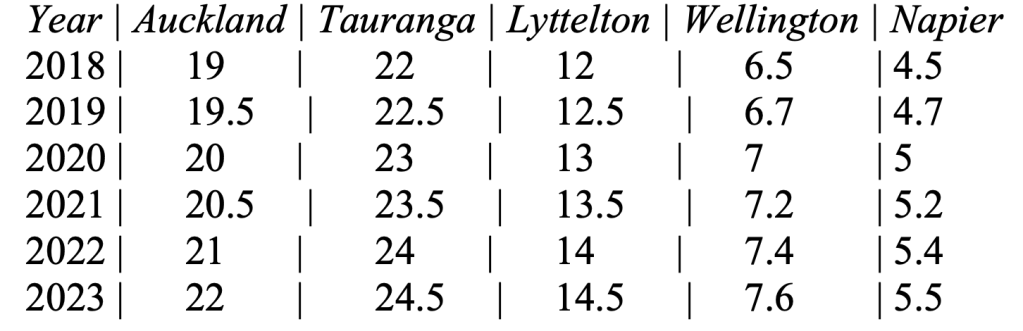
Infrastructure Projects: New Zealand is actively investing in the modernization and expansion of port infrastructure. Recent years have seen projects to expand container terminals at Auckland and Tauranga ports, as well as the construction of new storage facilities and logistics centers. However, some ports face challenges with aging infrastructure, requiring additional investments in equipment upgrades and repairs.
Ecology and Labor Safety: New Zealand’s ports strictly adhere to ecological and labor safety standards. Programs have been implemented to reduce greenhouse gas emissions, use renewable energy sources, and manage waste disposal. Special attention is given to the safety of port workers, with regular training sessions and equipment inspections.
Stevedores and Dockworkers: Ports in New Zealand employ skilled stevedores and dockworkers who ensure efficient loading and unloading of cargo. Major stevedoring companies include Ports of Auckland, Port of Tauranga, and Lyttelton Port Company.
Port Ownership: Major ports in New Zealand are managed by both public and private entities. For example, Port of Auckland is managed by Auckland Council, while Port of Tauranga is a publicly traded company listed on the stock exchange.
Port Locations:
Auckland: North Island, the largest city in New Zealand.
Tauranga: North Island, Bay of Plenty region.
Lyttelton: South Island, Christchurch city.
Wellington: North Island, the capital of New Zealand. Napier: North Island, Hawke’s Bay region.
Types of Ships Serviced:
New Zealand’s ports can service various types of vessels, including:
- Container ships (up to 18,000 TEU at Tauranga port)
- Oil tankers (up to 300,000 tons)
- Bulk carriers (up to 200,000 tons)
- Roll-on/roll-off (Ro-Ro) vessels (car carriers)
- Cruise liners (up to 5,000 passengers)
Challenges and Issues Faced by New Zealand Ports
New Zealand ports face several challenges and issues that can impact their efficiency and competitiveness. These challenges include both internal and external factors affecting port operations. Here are the main challenges:
Infrastructure Constraints
Aging Infrastructure: Many New Zealand ports have outdated facilities and equipment requiring significant investments for modernization and upgrades. The need for repairs and infrastructure updates can lead to temporary operational disruptions and increased operating costs.
Limited Capacity: Existing infrastructure sometimes cannot cope with the growing cargo volumes, especially in high-traffic ports like Tauranga and Auckland. Limited space for terminal and warehouse expansion hinders the increase in capacity.
(End of introductory fragment)
 marinejournal.info