
ABOUT THE WAYS TO INCREASE THE ECONOMIC EFFICIENCY
OF THE RUSSIAN FAR EAST PORTS’ INFRASTRUCTURE
Nikolai I. Pereslavtsev
Admiral Nevelskoy Maritime State University, Vladivostok
Abstract: Author analyzes ways to increase the efficiency of seaports in the Russian Far East using the example of the Republic of Korea, mostly the port of Busan.At the beginning, for readers’ better understanding, the general principles of operation for any seaport and their importance in the economy of a particular country are considered. The author believes that reliability and efficiency are the main principles in this matter, and explains what these concepts mean. As well, he discusses how South Korean ports have reached the level of developed logistics hubs and what can be learned from this experience for application in Russia.
Keywords: seaport, cargo turnover, efficiency, shipbuilding, ship repair, logistics hub, Busan
To determine how to increase the economic efficiency of the Russian Far East ports, let’s first examine the general principles of any port operations.
A seaport is a complex of appropriate infrastructure designed to handle cargo and fishing vessels as well as to provide services for passenger traffic. Ports are communication “hubs” connecting sea, river, railway, road, pipeline, and other kinds of transport, and in many ways ensure the country’s foreign trade and economic stability. Traditionally, a convenient geographical location has always been chosen for the location of port facilities in a wide bay with sufficient depths, closed from external winds, with the necessary space for any number of docking facilities.
Vessels approach the piers for loading and loading. Nearby or in the immediate vicinity are tracks for rail or road transport, which provide the supply of goods for export or transportation to other regions. The greater the volume processed by the port, the higher the income it brings to the government due to rates, charges, taxes, tariffs, etc.
The above scheme is basically permanent. If there are details they depend on specific geographical, historical, and economic factors affecting the operation of each individual port. Therefore, any country adjoining the sea has an interest to ensure smooth and efficient operation of its “sea gates” in order to achieve both domestic and foreign goals of its policy.
What is smooth, failure-free operation and what is efficient operation of the port and how they may be provided?
Failure-free operation (reliability) – is a property of the technical systems in port facilities to remain operational with a minimum number of failures per time unit during transshipment, storage and passenger processes. Reliability is closely related to the speed of ship handling, and thus efficiency and growth of cargo turnover to the maximum level [1];
Efficiency is the ability of a port or its sectors to achieve maximum performance with minimal time and financial costs.
When assessing the chances for efficiency increase the following factors are considered [6].
*Logistical and technological factors
a) availability of modern and high-performance automated systems based on innovative technologies for loading, unloading and servicing ships;
b) level of automation and introduction of new technologies;
c) access roads;
d) environmental safety standards;
e) quality of the logistics service;
*Geographical and climatic factors
a)port’s location on key international shipping routes;
b) existence of deep-sea approaches, weather conditions, (ice, storms, natural disasters)
* Economic, institutional and market factors
а) social and economic situation in the country and in the region;
b) volume of legal and information support for port activities;
c) management level (interaction with city and regional authorities, ability to attract customers with the best conditions in the terms of speed, cost and quality of service, labor organization, speed and accuracy of document processing);
d) port’s ability to respond to market changes, innovate and adapt to changing environmental conditions.
If all or most of the above points are positive in relation to a particular port, then this port has the potential for economically profitable and successful operations.
Now, based on this set of “theoretical ideas” let’s try to understand the details by using the example of South Korean ports because among marine specialists they are well-known as definitely effective.
Up until the early 2020s, South Korea logistics hubs (Incheon, Ulsan, Gwangyang, and Tonghae) attracted foreign (and Russian, too) businessmen, captains and shipowners with their clear competitive advantages. (The impact of global social and economic processes after 2020 is a topic of separate research).
Some of these advantages are:
– More favorable conditions for the wholesale distribution of fish products, provision of fuel and maintenance services. While port fees in South Korea are higher, the price difference is compensated by time efficiency: vessels are processed more quickly and spent significantly less time idle compared to those in Russia, as all port services operate smoothly. For instance, it was calculated (2020) that the average total time for arrival and departure of a vessel in Russia is 80 hours, in Busan – 30. Bunkering of a ship in Russian Far Eastern ports takes an average of 6 hours, in Busan – 4 [3;8]. Specialized services, like those that use AIS (Automated Identification System) technology, help speed up customs and warehouse processes, monitor and manage ship traffic, and basically minimize waiting time for ships;
– Technological automated equipment and high standards of service. For example, in Busan there are refrigerators for large-volume seafood, in which the fish is not only packed but is also sorted into 12 names. Each refrigerator has its own marketing service: the fisherman is immediately offered ready-made options for the sale of products [3];
– Specialized terminals (containers, chemical goods, oil, gas) with the capability to handle vessels of any size;
– Multimodal transportation within and around the port, with quick reload from sea vessels to railways and road transport. Quick reload is carried out using modern STS (ship-to-shore) cranes (transporter crane for container handling, automated warehouse systems, and digital technologies for cargo flow management.
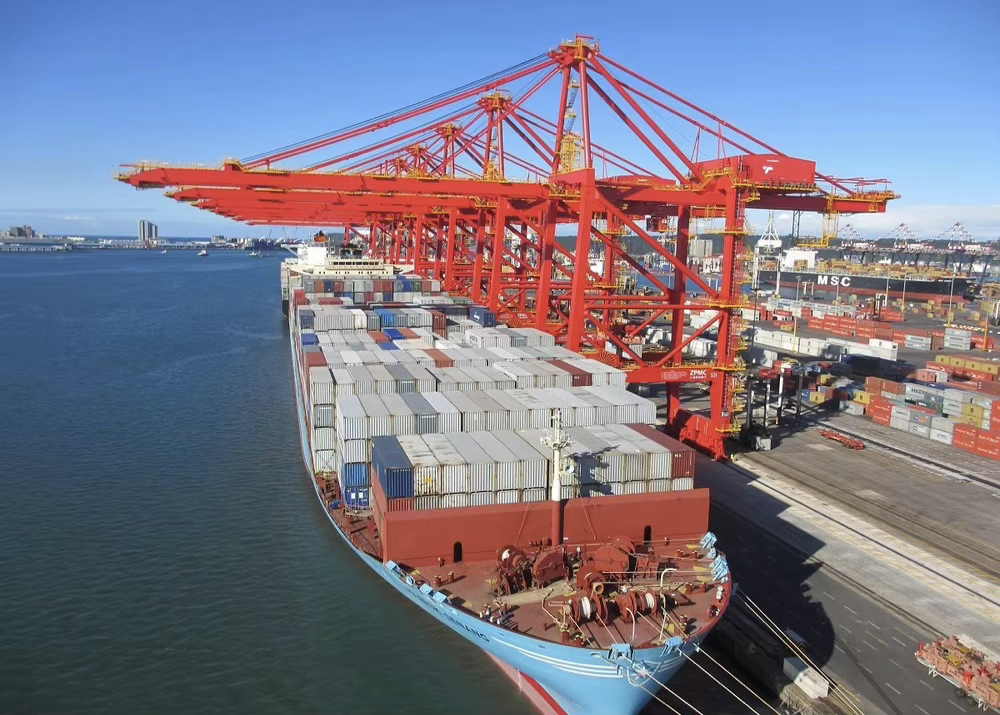
Pic.1 STS-crane and container vessel
The roots of South Korea port advantages go back to 1960s, when the central authorities identified shipbuilding, repair and port infrastructure as the basis for the country’s economic growth. They started to invest broadly in these fields, as a result, there was done a serious impact for modernization and innovation based on the latest economic achievements.
Therefore, each South Korean port not only ensures the stability of foreign trade operations. Ports also contribute to development of innovative technologies, primarily in the fields of “automation” and “computerization” because they focus on the introduction of these technologies into their production processes. This not only increases the efficiency of port operations, but also helps to find and fix any problems in the innovation process, and make sure the new technologies are very needful and efficient.
Let’s consider the port of Busan as an example.
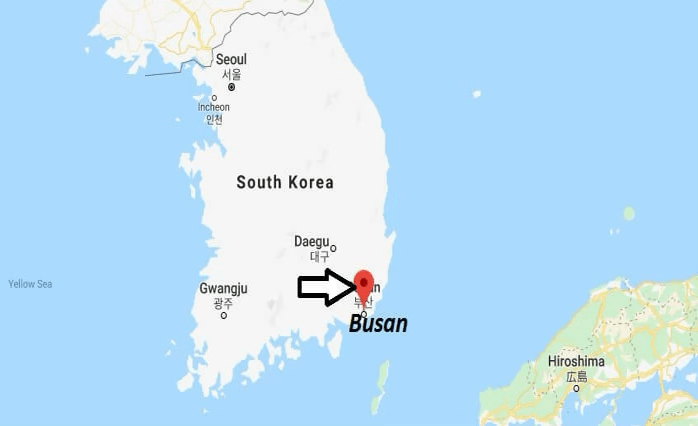
Pic.2 Port of Busan on the map
The port of Busan is accessible to ships with a displacement of more than 200 thousand tons, a length of up to 330 m and a draft of up to 15 m [8;9;11]. The length of the mooring front is more than 10 km; 10 anchorages are organized in the inner harbor, 17 in the outer harbor [7;8;9]. The total number of wharves is more than 40, including 17 deep-water ones. Up to 90 vessels, including ultra-large container ships, can be accepted simultaneously [8].
The port includes advanced modern technologies:
- radar-assisted pilotage system for ships;
- terminal-to-terminal transportation between port areas;
- recycling network (modern devices that automatically sort and clean PET plastic). Among the modern equipment used for processing plastic, as well as other hard materials (metal, wood, etc.) hydraulic presses, grinders, extruders, granulators and other equipment are actively used;
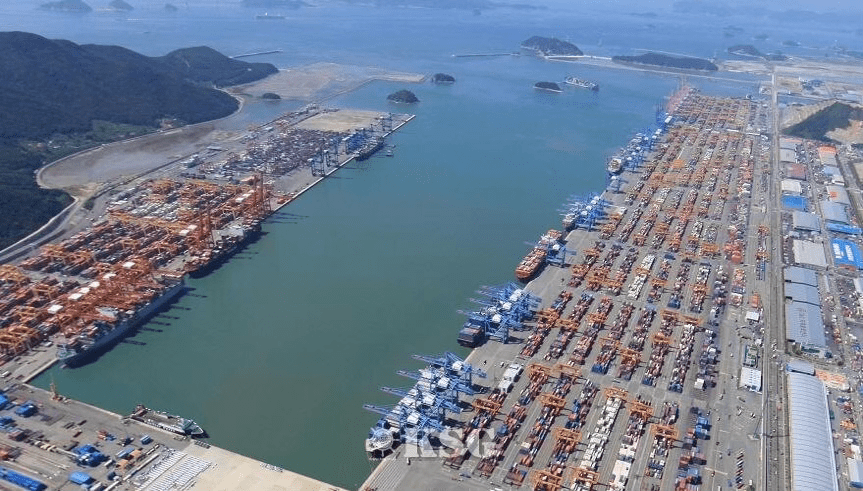
Pic 3. General view of one of the areas of Busan port
- system for tracking, warehousing, moving, arriving and dispatching goods (U-port security and control system). This system is used for clear organization and execution of work. Direct communication is carried out using information and telecommunication technologies, including RFID (Radio-Frequency Identification), GPS (Global Position System) and USN (Ubiquitous Sensor Network) [18].
The following innovative technologies are also available:
* Electronic navigation devices. They allow operators to track the vessel’s drift, speed and direction and warn the vessel of danger in advance.
* Computer software developed specifically for the port of Busan to handle mooring operations with vessels of different sizes and tonnages.
* Emergency notification system. Uses LTE technology to transmit automatically the location of those who are facing emergencies. For example, if a person falls into the water, the system is triggered by the opening of the life jacket and sends notification to the the ground base at a distance of up to 100 km
* Technology for monitoring the safety of container stowage. It uses video surveillance cameras and lidar sensors to track the angle of upper and lower containers. Artificial intelligence methods such as “deep learning” are used to classify (and then to notify about) security states automatically: normal (green), dangerous (yellow), and very dangerous (red).
The annual cargo turnover – 450 million ton: oil, petroleum products, coal, construction materials (cement, sand), containers, grain, scrap metal, iron ore [9]. Logistics hub (40% of South Korean sea cargo turnover), container transportation (80%), general, “ro-ro”, bulk, rolling cargoes [17]. In 2023 – 22.75 million TEU. The immediate goal is 30 million TEU [10;13;16].
The port consists of 7 areas. Area №1 is located in the Northern Inner Harbor, area №2 and №3 – in the Northern Outer Harbor, area № 4 — in the Southern Outer Harbor, area № 5 — in Kamnaepo bay, area № 6 — in Dadaepo bay, area № 7 — in the western part of Suyongman bay [8]. Areas also differ by names.
Northern Port (Northern Harbor) – passenger traffic (here is Marine Passenger Terminal), container and general cargo [16];
Southern Port – it processes 30% of the country’s total seafood production, as well as bulk cargoes (coal, grain, iron ore).1 million ton of marine products in a year. The port includes the huge fish market, 250-350 ton of fish are sold daily. [3;8].
Gamcheon – it is used when additional processing capacities are required for large cargo volumes. Complements the main functions of the Northern port. Ocean fishing vessel maintenance, cement transshipment, ship repair. Grain terminal with 104 elevators for more than 100 thousand ton of grain is located at wharf №5. One ship can be processed at the same time. The main product range is wheat and corn from the USA, Canada and Australia (i.e. food imports) [8].
Dadaepo– coastal transportation and fishing, smaller cargo operations [11;16];
Busan Newport – Equipped to handle large container ships, including vessels ones with a capacity of up to 20,000 TEU. It has a modern container terminal [20] with automated equipment (including AGV robots), opened in 2024. It is expected that automated cargo transfer from ships (remotely operated cranes of domestic production are used for this) will increase the port’s productivity by 20% compared to other terminals and significantly reduce the risk of security incidents [13]].
The capabilities of remote-controlled equipment (cranes) are being developed, in particular, with the support of “LG U+” Company (a network mobile operator, part of LG Corporation).
“LG U+” Company has installed 5G network stations and crane remote control system at Busan Port and aims to commercialize 5G network technologies for automated management of seaport infrastructure. High-resolution video signals from sensors and cameras on the crane are transmitted to the control room via a 5G network. The operator receives these signals and uses them to activate the control system. This technical idea allows remote control of cranes for loading and unloading containers from cargo ships, while watching screens from the control room in another location of the port.
According to the Company explanations, 5G network is necessary to minimize delays and enable operators to monitor in real time the operation of cranes. As well, this technology improves operational efficiency. While before that four to five workers were needed to operate a single crane, the telecommunication company’s new technological concept allows one operator to control simultaneously four cranes from a control room. This technology can also help lower the safety risks and expenses for crane operators who have to work in a cabin at the very top of each crane. As a result, the high labor costs and insurance premiums that are often associated with these jobs can be reduced. The use of 5G technology in crane remote control systems significantly reduces the the time required for workers to become proficient in operating cranes. “LG U+” stated that it takes only a month of training to operate cranes from a remote office, whereas previously it could take three years for employees to get proficient skills in their work. According to “LG U+”, it will continue to invest in the implementation of other technological concepts to automate the port infrastructure. These include unmanned terminal tractors (port tractors), unmanned forklifts and drones that control the movement of cargo in the port [15].
All areas of Busan Port are the parts of Free Economic Zone “Busan-Jinhae“. In addition to the port infrastructure itself, FEZ “Busan-Jinhae” includes an industrial production complex, a scientific and industrial complex, a maritime logistics center, a scientific development center and a business center. Each of these elements contributes to effective economic activity of the regional hub and the national economy of the Republic of Korea as a whole.
According to the Law of 2002 “On establishment and management of Free economic zones” the work of FEZ “Busan-Jinhae” is regulated by committees, services and agencies of the Ministry of Economy and Finances as well as by other offices being involved. The Port Authority (Busan Port Administration) resolves detailed issues related to the port itself with the city authorities in order to integrate the development of the port into the general development plan of the city. At the same time, coordination mechanisms such as regular meetings, discussions on joint strategies, joint private and public funding help to resolve problems quickly and ensure that work is carried out evenly and steadily [22].
Key directions of this joint work:
а) Transformation of the Northern Port. Production facilities are being transferred step-by-step to Busan Newport. This allows to transform old port territory into multifunctional city complex with dwellings, commercial objects, parks and cultural spaces. The goal is to return the coastal area to ordinary citizens and create new growth points for the local economy;
b) Development of Busan Newport. It is believed that expanding the capacity of Busan Newport will significantly increase the powers of Busan Logistics Hub and raise the status and importance of the city as the center of political and business activity in Northeast Asia;
c) Infrastructure connection: The innovations of the port infrastructure are being coordinated with the city’s plans to improve transport networks (railways and roads) to ensure efficient communication between the port and domestic logistics centers;
d) Eco-port. Busan Port Administration and the city government plan to make the port more environmentally friendly. By 2050, they aim to increase the share of renewable energy sources in the port to 100%. For this purpose , solar, wind, and hydrogen power plants are being built;
e) Reducing harmful garbage and emissions. Efforts are being made to reduce greenhouse gas emissions, including through the transition to environmentally friendly port equipment and the provision of infrastructure for ships by the use of clean fuels (methanol, ammonia) [8]
f) Eco-Delta-City. Development of «Eco-Delta-City» in the mouth of Naktongang River. An example of harmonious coexistence between industrial development and nature is the project to create an ecological park and protect habitats for migratory birds. This demonstrates the city’s dedication to sustainable development.
g) Computerization. Port Administration implements smart logistics systems, automation and computerization to increase the efficiency and competitiveness of the port and the city as an international trade center. One example of this is the Chain Portal platform, which optimizes online transaction processes [8].
Thus, if we plan to promote the idea of full-fledged, high-performance logistics hub based on one of the existing Far Eastern ports or to build a new one in a specific geographical location [19], we can consider technological concepts that have already been successfully applied in South Korea [21].
а) Automated cargo flow management systems – implementation of automatic planning, optimization and control systems for loading and unloading operations;
Includes the following:
– Installation of automatic cranes, gantries and mobile robots. This increases the speed and safety of operations;
– The use of Automated Guided Vehicles (AGV) to move inside the port;
– The use of warehouse stock management and vehicle tracking systems.
b) Automated navigation, positioning, surveillance and ship management systems;
Includes the following:
– The use of automatic positioning, monitoring and ship management systems (AIS – Automatic Identification System), ECDIS (Electronic Chart Display and Information System) in order to increase safety and efficiency.
c) Implementation of ATS (Applicant Tracking System) technologies. The main goal of ATS is to simplify and speed up the recruitment process, while ensuring high-quality hiring [14];
The processes automated by ATS:
- Publication of vacancies packet on several sites at the same time;
- Collecting and keeping resumes in a single database;
- Automatic sorting and filtering of candidates;
- Interaction with candidates as part of the system;
- Creation of analytical reports
d) AI (Artificial Intelligence) logistics and cargo tracking systems – the introduction of IoT (Internet of Things) devices. Internet of Things – combination of physical devices with Internet access that collect, analyze and exchange data without human interference [4];
e) Automated systems of safety and video-control
Includes the following:
– installation of cameras equipped with analytics and access control systems.
f) Automation of customs clearance and cargo certification through interaction with customs services
Includes the following:
– Implementation of platforms for electronic document exchange.
g) Using an analytical service that is based on modern integrated platforms for data analysis and cargo handling
Includes the following:
– Application of data masses and machine learning of personnel to optimize cargo operations
h) Automation for lowering ecological risks
Includes the following:
– implementation of emission monitoring and automatic environmental management systems. These technological concepts make it possible to increase efficiency and security of port operations, reduce costs and cargo handling time [3].
Let’s leave it to the logistics experts to figure out how to combine productivity and functionality with the Far Eastern ports. On our own behalf, we’ll just say that, in our opinion, it is extremely significant for Russia to create a modern maritime transport hub in the Far East. Over the past five years due to global geopolitical, economic and foreign trade changes we have once again become convinced of the importance of this initiative.
Based on the analysis of data about South Korean ports, it may be concluded that the implementation of plans to increase the economic efficiency of Russia’s Far Eastern ports requires joint efforts by federal, regional, and local authorities in such directions as drawing up construction and financing plans, attracting contractors and performers, skilled specialists etc. But this transport hub does not necessarily has to be associated specifically with Vladivostok.
REFERENCES:
1. Reliability. Technical library / Безотказность. Техническая библиотека Neftegaz.RU, веб-портал, URL: https://neftegaz.ru/tech-library/ngk/147841-bezotkaznost-reliability/
2. Launching of the “dry port” in Primorye will take place on the Eastern Economic Forum / Запуск «сухого порта» в Приморье» состоится на Восточном экономическом форуме, 23.05.2025, URL: https://primamedia.ru/news/2089706
3. I.V. Pavlova. Busan: sea gates of South Korea / И.В. Павлова. Пусан: морские ворота Южной Кореи, URL: https://geo.1sept.ru/ view_article.php?ID=200902314
4. Internet of Things: how smart devices change our life / Интернет вещей: как умные устройства меняют наш быт, URL: https://skillbox.ru/media/ code/internet-veschey-kak-umnye-ustroysatva-menyayut-nash-byt/
5. How technology-driven innovations transform operations in maritime ports and logistics / Как технологические инновации революционизируют операции в морских портах и логистике, URL: https://portsinfo.ru/ports-news/innovatsii/170811-kak-tekhnologicheskie-innovatsii- revolyutsioniziruyut-operacii-v-morskikh-portakh-i-logistike
6. Ksenzova N.N. Methods to estimate competitiveness of maritime ports. Admiral Uhakov Maritime State University, Novorossiysk, Russia / Ксензова Н.Н. Методы оценки конкурентоспособности морских портов, Государственный морской университет имени адмирала Ф.Ф.Ушакова, г. Новороссийск, URL:https://iesm-journal.ru/wp-content/vypusk_2025/METODI-OTSENKI-KONKURENTOSPOSOBNOSTI-MORSKIH-PORTOV.pdf
7. Logistics and infrastructure of South Korean maritime ports: map and capacities / Логистика и инфраструктура портов Южной Кореи: карта и возможности, 2024, URL: https://portsinfo.ru/ports/porty-yuzhnoj-korei/908-port-pusan
8. Busan – sea gates of South Korea / Пусан – морские ворота Южной Кореи. Studwood – веб-портал, URL: https://studwood.net/710357/ekonomika/rayony_porta_pusan_#496
9. Port of Busan, Ruwiki / Порт Пусана, Рувики, веб-портал. URL: https://ru.ruwiki.ru/wiki/Порт_ Пусана
10. Port of Busan by 2025 will become a world logistics hub / Порт Пусана до 2025 года должен превратиться в мировой логистический хаб, Primamedia, 27.06.2019, URL: https://primamedia.ru/news/826458
11. Port of Busan, South Korea / Порт Пусан, Южная Корея, 01.01.2024, Kruiz.ru – веб-портал, URL: https://kruiz.ru/blog/ kruizy/port-pusan-yuzhnaya-koreya/
12. Port of Busan (Pacific Ocean), Russian Submarine Fleet, web-portal / Порт Пусан (Тихий Океан), Подводный флот России (веб-портал), URL: https://podlodka.info/education/17-navigation/216-port-pusan-pacific-ocean.html
13. South Korean port of Busan / Южнокорейский порт Пусан, Crew Hunter Maritime Agency – веб-портал, URL: https://vk.com/wall208567606_3375
14. ATS (Applicant Tracking System) in recruiting, what is this system for /ATS (Applicant Tracking System) система для HR: что это в рекрутинге и зачем она нужна, URL: https://моя команда.рф/blog/stati/ats-systema-dlya-hr
15. LG+ launches projects based on 5G for maritime ports / LG U+ запускает решения на базе 5G для морских портов, 02.05.2021, URL: https://dzen.ru/ a/YI55cP4QbVkiidwO
16. Sea freight in Busan port, URL: https://logisticiran.com/en/blog/show/109/sea-freight-in-busan- port
17. Freight Forwarder Services, веб-портал, URL: https://freightforwarderservices.com/busan
18. The name of this port is Busan, “Maritime ports”, №10 (81), 2009, pp. 42-45 / Имя этого порта – Пусан, страна – Южная Корея, «Морские порты», №10(81) 2009, сс. 42-45
19. Project of logistics hub / Проект логистического хаба, 27.11.2024, URL: https://sseproekt.ru/tpost/op1It1a5h1-proekt-logisticheskogo-haba
20. AGV robots / Роботы AGV, URL: https://vc.ru/tech/1750714-roboty-agv
21. Automation in foreign ports, Russian concepts, “Russian Maritime news” / Автоматизация иностранных портов: российские решения, «Морские вести России», 11.11.2024, URL:http//morvesti.ru/analitika/1688/112509/
22. Legal regulation of special economic zones in the Republic of Korea, Zakon.ru – web-portal / Правовое регулирование особых экономических зон в Республике Корея, 25.09.2025. Zakon.ru – веб-портал, URL: http//zakon.ru/blog/2025/9/25/pravovoe_regulirovanie_osobyh_ekonomicheskih_zon_v_respublike_koreya

