
ABOUT THE PROSPECTS FOR IMPLEMENTATION OF INTERNATIONAL TRANSPORT PROJECTS ON THE KOREAN PENINSULA
Nikolai I. Pereslavtsev
Admiral Nevelskoy Maritime State University, Vladivostok
Abstract: The article analyzes (in view of the international
situation on October 2023) the prospects for the implementation of
international transport projects that are connected with the Korean
Peninsula. These projects exist for rather long time but remain, due
to the various reasons, mainly on theoretic level. Meanwhile, they
are undoubtedly interesting for the Russian Federation, since their
implementation is aimed, among other things, at ensuring regional
stability and security of the Russian Far Eastern borders. However,
to talk about the implementation of all these plans is possible only
taking into account many political and economic factors which affect
both the domestic situation in the Republic of Korea and the DPRK,
as well as the relations of the Russian Federation with them. The
author considers these factors in detail and makes conclusions on
this basis that correspond to the topic of his study.
Keywords: Republic of Korea, DPRK, transport projects,
Northern Sea Route, cargo transportation
The current international situation has made significant
corrections to the list and opportunities for the implementation of
international transport projects in Northeast Asia.
Since the part of these projects are directly related to the states
of the Korean Peninsula let’s consider the positions of the South
Korea and the North Korea on them.
Republic of Korea
An analysis of 2022-2023 results leads to the conclusion that at
present the Administration of president Yoon Suk-yeol prefers to
keep relations with the Russian Federation “on pause”. Export
control measures have been introduced against Russia, its banks are
disconnected from financial transactions. South Korean companies
allegedly suspended their business in Russia. At the same time, they
reserved the opportunity to return at any time. In 2023, imports of the
Republic of Korea from the Russian Federation decreased by 80%,
but exports there, on the contrary, increased by 25%, in particular,
for such items as cars, engines, nickel pipes [9]. The visa-free regime
is maintained.
All this suggests that South Korea does not want to lose the
Russian market completely, although for Seoul the Russian
Federation is not even among the top ten largest trading partners [3].
Seoul’s attitude towards the DPRK after beginning of Yoon
Suk-yeol president’s term in May 2022 can be described as
completely negative. All negotiations have been interrupted,
economic cooperation plans developed under Moon Jae-in (Yoons’s
predecessor) have been canceled. The government has indicated
principled position: no concessions to the North until it agrees to
discuss its nuclear program. And since it is unrealistic to expect this
(in September 2023, the session of the People’s Assembly of the
DPRK fixed the status of nuclear forces in the Constitution [14] and,
thus, the impossibility of their elimination), the resumption of interKorean contacts can occur only after the next appearance of left-wing
politicians in the South, if at the same time the next (after Yoon)
ROK president is able to reconsider tough foreign policy positions.
This leads to the conclusion that there is no reason to talk about
the DPRK’s involvement in multilateral transport projects with the
participation of the Russian Federation and the Republic of Korea in
the next few years. Not because Moscow does not want it, but
because Seoul does not want it. Here we are talking, first of all, about
the Trans-Korean Railway (TKR), the idea of which has been
actively discussed from time to time over the past 20-25 years,
especially at times of inter-Korean relations’ improvement.
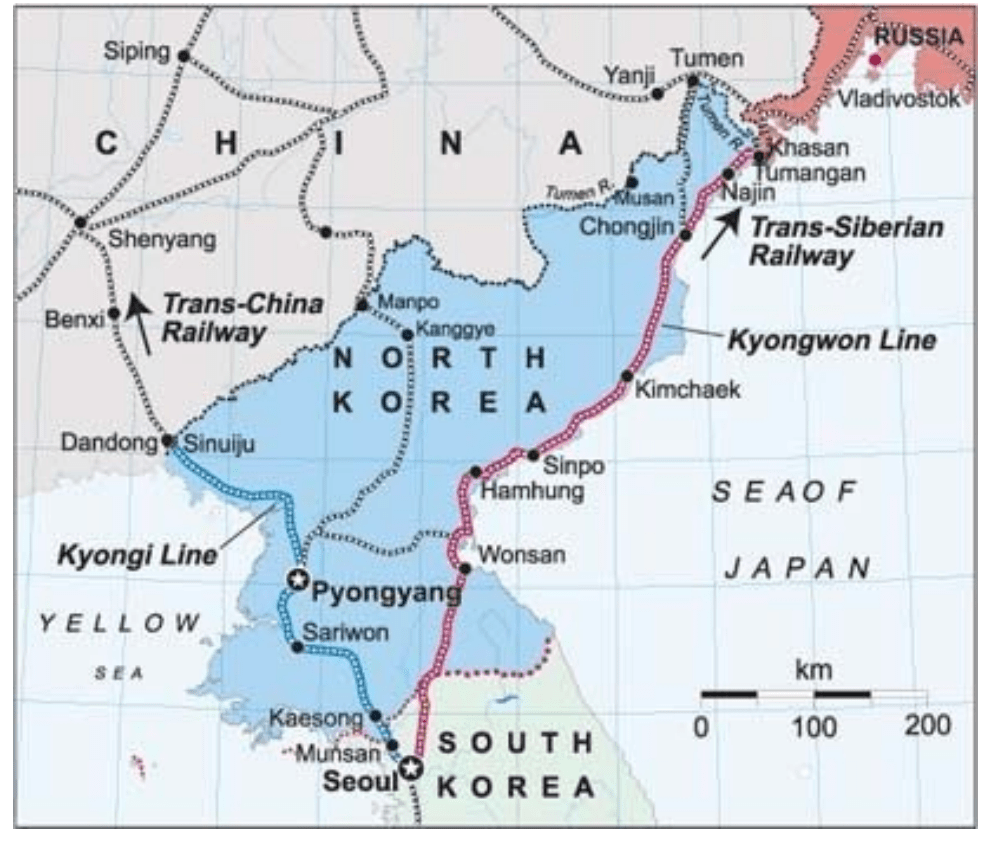
Trans-Siberian Railway
That for the first time the South Korean conception of this idea
appeared back in October 2013, when then-president Park Geun-hye
declared her “Eurasian initiative”. The aim of the initiative,
according to Park Geun-hye, was the organization of the Silk Road
Express transport corridor (running from South Korean Busan to
London through the territory of North Korea and Russia) and the
implementation of large-scale energy projects in the Russian
Federation, Central Asian countries and China. In other words, it
was, in fact, about the creation of the unified Euro-Asian economic
space from the Pacific Ocean to the Atlantic.
It is clear that the “Eurasian Initiative”, like all plans of this
kind, was developed by a large number of experts and reflected the
goals of South Korean business and ruling circles, interested in
increasing the geopolitical role of the Republic of Korea in the AsiaPacific. The transcontinental route is an important component of it.
It so happened that the prospects for its implementation within the
framework of the “Eurasian initiative” were not continued, primarily
due to the complicated inter-Korean relations. Negotiations on this
topic have periodically intensified, for example, during the brief
period of rapprochement between Seoul and Pyongyang in 2018-2019.
Then came the “Covid era”, in the South the presidential
administration was succeeded by the “right-wing” who came to
power in Seoul with negative positions towards the DPRK, and again
everything stopped.
However, this does not mean that the South Koreans
principally reject the idea of building a stable and economically
profitable transcontinental transit line to Europe.
It is clear that the project of such a line involves very serious
financial investments to ensure its capacity. This requires a modern
logistics infrastructure: high-tech port and railway equipment,
service maintenance of delivery vehicles, introduction of automation,
construction of transshipment and storage facilities, high-quality and
operational forwarding companies. On the Northern Sea Route it is
also required to provide transporters with prompt and high-quality
meteorological forecasts. But the main thing is in the first place –
how to guarantee a stable, and preferably two-way cargo flow, both
from East to West, and from West to East.
(End of introductory fragment)
 marinejournal.info