
ABOUT THE MEASURES TO COUNTERACT FACTORS OF NEGATIVE NON-ECONOMIC INFLUENCE ON PRODUCTION AND TRANSPORT-LOGISTIC SYSTEM (ON THE EXAMPLE OF THE RUSSIAN FAR EAST)
Nikolai I. Pereslavtsev
Admiral Nevelskoy Maritime State University, Vladivostok
Abstract: The author explains the concept of “transport-logistic system”, analyzes the content of its parts in relation to the Russian Far East. Then he notes: the state and frames of the Far Eastern (as well as any geographically different) logistics system are traditionally regulated by economic factors: market needs, the volume of import-export trade, the need to supply remote areas. Depending on political and historical realities, non-economic factors may also occur. For example, in the 21st century, the Far East faced the global COVID pandemic and an expansion of anti-Russian sanctions from the United States and its allies to put pressure on the Russian Federation. Russia is not the first country in such situation, so measures to counteract the negative influence were found quite soon and proved to be quite effective. The author further illustrates the taken steps with concrete examples and formulates his own proposals.
Keywords: transport-logistic system, transport infrastructure, logistics, maritime transport, non-economic factors, directions of cargo transportation, public-private partnership
General definitions
Transport-logistic system as a part of general production complex of the whole country or particular region is a group of interrelated elements and processes.
First of all, it is a transport infrastructure. For its maintenance, a system of logistic services is being implemented, information support and coordination of all involved participants’ work are carried out.
The components of infrastructure include: land, water and air routes, pipelines, sea and river ports, railway stations, airports, airfields, transport terminals, subways, high-speed transport systems and interchanges, as well as navigation and rescue equipment ensuring the safety of transport process.
Logistics services are (by type):
Warehousing, transportation, inventory management, distribution (interaction with buyers and intermediaries, export at the appointed time from the territory of port or railway junction, etc. Let’s take it for granted that logistics services are implemented depending on the quality and volume of work of infrastructure component parts.
So let’s start by looking at these parts.
Transport infrastructure component parts in the Russian Far East
Each component is serviced by accompanying network of facilities (temporary storage warehouses, loading complexes, depots, refueling points, staff accommodation, etc.)
– Rail and auto transportation. The main element of the railway network in the Far East is the Trans-Siberian Railway (TSR), through which goods and cargo can theoretically be delivered to the European part of Russia and further, to Western Europe;
-River transportation. Along the rivers of Siberia and the Far East, raw materials, as well as industrial and consumer goods are sent to recipients either through the Northern Sea Route (Siberian rivers – Lena, Yenisei, Ob) or across the Sea of Japan and the Sea of Okhotsk through the seaports of Sakhalin and Primorye (Korsakov, Vladivostok, Nakhodka, Zarubino);
-Sea transportation. Since long ago the ports have served as strongholds of Russia’s political, commercial and military influence in the region, and, most importantly, as transit points for providing remote territories (Сhukotka and other polar areas) with everything they need and maintaining stable trade and economic ties with the Asia-Pacific.
The work and forms of the Far Eastern (as well as any other, geographically different) logistics system are traditionally regulated by economic factors: market needs, the volume of import-export trade, the need to supply remote elements.
However, it is known from history that at certain moments due to specific regional or global political realities non-economic factors also had to be taken into account. For example, due to territorial redistribution after Russo-Japanese war of 1904-1905 Russia at first had to construct marine elements of regional transport-logistic system taking into consideration the Japanese possession of Kurile Islands and Southern Sakhalin. After 1945 they returned to the USSR, and the directions and frequency of sea routes were adjusted again. The volume of traffic changed, this required a reorientation of flows, investments in port management system, provision of ports and railway junctions with necessary materials.
In the 21st century the Russian Federation faced a different kind of non-economic negative influence in the Far East. Since 2020 it has been a worldwide COVID pandemic. Asia-Pacific countries one after another introduced strict preventive measures, including in contacts with the outside world.
For example, in China the volume of cargo transportation decreased by 18,4% in early 2020 compared to the same period in 2019 [1]. Accordingly, this affected exports and imports from the countries, neighboring with China (including Russia). North Korea has closed its closed its borders altogether, even for passenger traffic.
In 2020-2022 railway transportation there from the Russian Federation fell to 20 tons per year, and only in 2023, after North Korea lifted restrictions and increased coal exports, they reached 13,223 tons. By the beginning of May 2020, the losses of the transport sector in Russia exceeded 230 billion rubles [1]. The delivery time of goods has increased, transportation along traditional international cargo routes (around Asia, across the Indian and Pacific Oceans, to ports in Europe, the USA and South America) descended to a minimum. Only the levels of Fаr Eastern ports remained the same and even slightly increased, due to the gradual transfer of directions and the number of deliveries [3].
Another non–economic factor is the Western sanction attack of the United States and its allies on Russia after beginning of Ukranian conflict (the West’s restrictions against Moscow have always existed historically in one form or another), and, as a result, the transition of previously traditional Russian partners into the category of “unfriendly”.
In the Russian Far Eastern borders South Korea and Japan also supported US sanctions and have become “unfriendly’ partners for Russia.
Both, Seoul and Tokyo have forbidden to export many kinds of goods to Russia, particularly high-technology ones. For example, Japan has stopped exporting semiconductors, communications equipment, software, oil refining equipment, trucks, railway locomotives and other electrical equipment [5]. South Korea imposed its bans in approximately the same framework, only at first in a milder version. In addition, container carriers refused to operate on routes between major South Korean, Chinese, Japanese and Russian ports [6]. Due to these processes, Moscow’s efforts to reorient part of the cargo flow from western directions could not give full effect.
That is, as a result of the drop in exports and imports, the volume of interstate trade (especially goods with high added value) and the load on port facilities decreased, railway and automotive logistics suffered.
In other words, the transport and logistics system of the Russian Federation first experienced a shock, but then began to rebuild, switching to alternative or “grey” schemes. By now, the efficiency of Russian logistics system has almost reached the previous (pre-crisis) level.
There are most significant reorientation ways for transport-logistic system (i.e., land and water transport infrastructure and logistics services) under the pressure of outer non-economic restrictions. All these ways are interconnected, we can say that they follow one from another.
By the way, it is no need to say that they have not been invented in Russia. The Russian Federation simply took advantage of many other countries’ experience which had found themselves in similar circumstances throughout their history.
1. Creation and expansion of alternative means, directions and schemes for cargo transportation.
Means: For example, if foreign ports and sea routes become inaccessible for national flag, than a “ghost” fleet can be used. The ships are put on cargo lines and work quite successfully. In 2022 the Russian Federation thus acquired, according to various sources, from 120 to 300 tankers and bulk carriers officially registered in neutral or “friendly” countries [2]. They are certainly not new, their cost corresponds to vessels’ age, but they are still quite capable to serve for several years more. Such vessels have visited also Primorye Region ports. In particular, in Vladivostok, one could repeatedly see African flags.
Directions:In Russia, the prospects for development of the Northern Sea Route (NSR) are actively discussed, with the aim to reach specific, substantive decisions [9]. An increase in cargo traffic, which means positive impact on ports serving the Arctic route, should be guaranteed by measures to ensure safety, reliability and profitability of navigation, and modernization of port infrastructure.
There are different ways to consider the announced volume of cargo transportation by the NSR by 2030. In November 2024, the President of the Russian Federation announced the “milestone” of 100 million tons [9]. One thing is indisputable: everything possible is being done in Russia to achieve this result. here is an understanding: to make the NSR (as one of the alternative directions) to work with full efficiency, a sovereign large-tonnage cargo fleet (a mean of freight transportation) with gas and container ships, bulk carriers, oil tankers [8] and icebreakers escort is needed.In November 2024, the “Chukotka”, project 22220, was launched at the Baltic Shipyard in St. Petersburg [8]. (Pic.1)
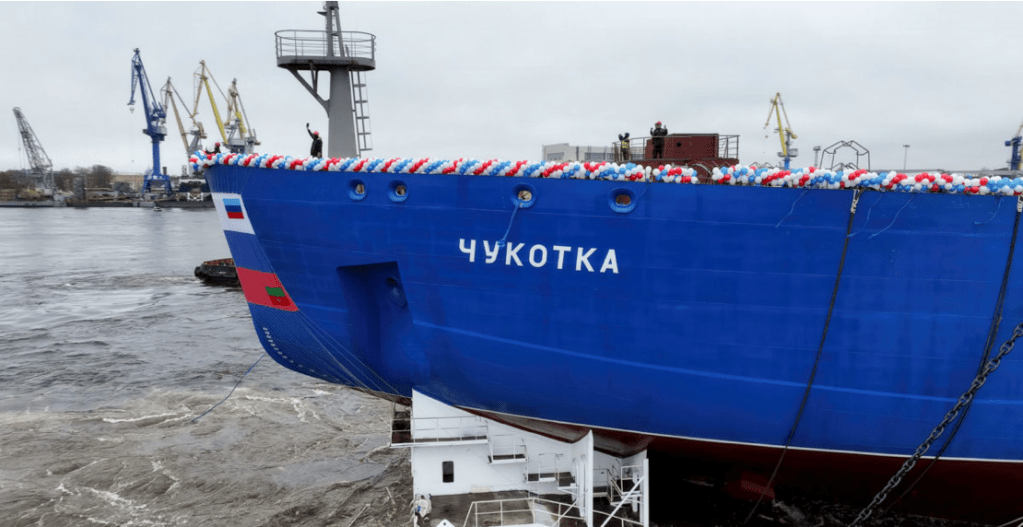
Pic.1 Launch of icebreaker “Chukotka”
The first ship of the modernized version – project 10510 “Leader” (Pic. 2) is under construction at the «Zvezda» shipbuilding complex in Bolshoi Kamen (Primorye).
The main peculiarity of both projects is the use of variable draught. This allows to work effectively both in deep waters of sea basin and in Siberian rivers. In total, the “Zvezda” shipyard has 26 large-tonnage vessels in its order portfolio [9].
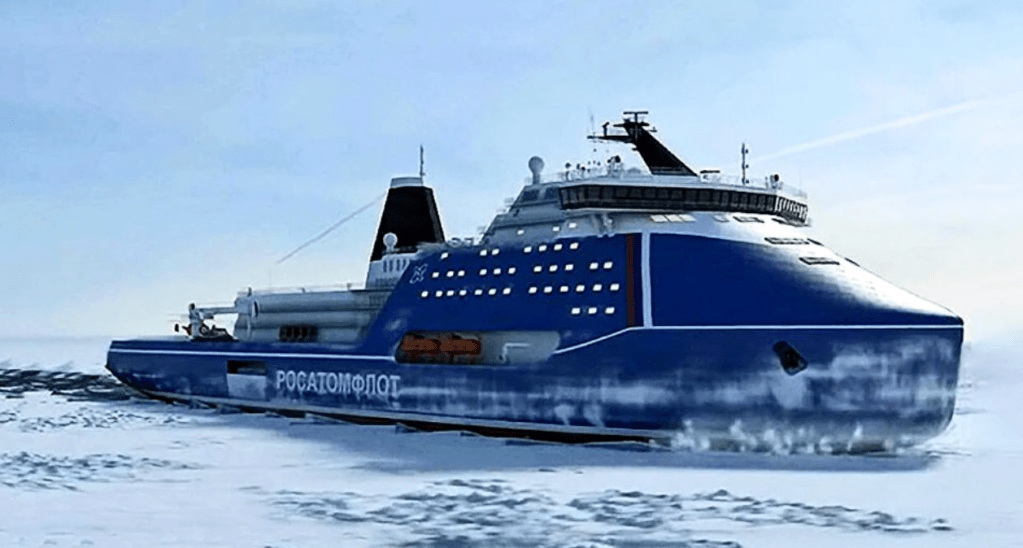
Pic.2 Icebreaker “Leader” with variable draught, project 10510
Schemes: In neutral or “friendly” countries intermediary trading companies with official or actual Russian participation are being opened, they are used for acquiring and transportation from Asia-Pacific countries of anything: from oil to consumer electronics and cars. For example, first, the product is imported from “unfriendly” country, let’s say, to China or India. Then the intermediary, receiving a certain profit margin, redirects the goods to Russia.
New ways of insuring marine and automobile freight and passing financial payments have been found and are currently under operation [2]. Relations are being developed with partners who previously had a limited positions on the Russian market. For example, Russian consumers in Far Eastern regions met with the offer of North Korean clothing and shoes. Until now, the Russians had a very vague idea about them, now there appeared a real chance to verify their quality.
Thus, despite the difficulties and problems, in general, we do not observe a critical decrease of goods’ volume coming from the Asia-Pacific.
2. Development of domestic production: processing of raw materials for domestic and export use, expansion of the range and quantity of industrial and consumer goods offered to the market.
It seems that any state has a direct interest in this aspect – from obtaining additional finances for further investments, including in transport infrastructure, to solving social issues. The main method here is to expand the scope of public-private partnership (PPP) and assistance to small and medium-sized businesses.
Below is an example of the effective use of public-private partnership in the Russian Far East.
To begin with, let us recall, that PPP is a form of interaction between the state and private business for construction/reconstruction and operation of socially significant infrastructure facilities. The main idea is to attract private (including foreign) investments and competencies to infrastructure field, controlled by the state.
One of PPP types is the creation of special economic zones (SEZ). If we consider SEZ as a generalizing term, which includes various kinds and forms, one of these forms may be the territories of advanced development (TAD, Russian abbreviation – TOP)
In accordance with this, in 2022 in the Amur Region TAD “Amurskaya” has been established, which included the boundaries of previously created TADs with a total area of almost half of the Amur Region [10].
TADs are usually created for specific economic projects. Within the territory of TAD “Amurskaya” the most significant projects are Amur Gas Processing Plant (“Gazprom”, represented by a subsidiary “Gazprom Pererabotka Blagoveshchenck” (Pic.3) and Amur Gas Chemical Complex (“Sibur Holding” with Chinese “Sinopec”) in the vicinity of Svobodny (city in Amur Region) [10].
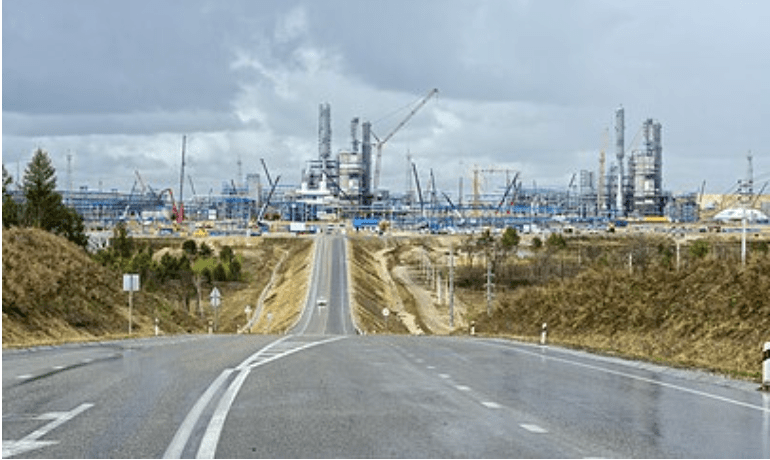
Pic. 3. Amur Gas Processing Plant in the process of construction
According to experts, the site near Svobodny was chosen taking into account transport logistics. A pier has been constructed on the river Zeya for the delivery of large-sized equipment by Gazprom-owned vessels with a small draught (barges, pontoons). Railway and automobile tracks were connected with the Trans-Siberian Railway and the federal highway. As well, It is possible that the nearness of such a strategic facility as the Vostochny cosmodrome also was taken into consideration.
Since 2017 (the start of projects construction) the budget of Svobodny has received 3.7 billion rubles [4], due to which the appearance of the city has changed significantly. Moreover, a self-reliant (independent of the city’s infrastructure) city-block has been constructed in the northern outskirts for the staff of two companies. To assess the amount of funds invested in construction of the city-block, education facilities and the city infrastructure as a whole, you need to see everything with your own eyes. The results are immediately available – specialists from all over the Amur Region and even from the Far East as a whole are coming here.
The products of Amur Gas Chemical Complex (base polymers for industrial and household spheres), in addition to domestic consumption, are also intended for export to neighbors in the Asia-Pacific. And transportation to consumers is an additional loading of Far Eastern railway, automobile and port infrastructure with domestic goods, regardless of non-economic factors of foreign origin.
Now let’s discuss Primorsky Region. In the Region we have 4 TADs: “Bolshoi Kamen”, “Nakhodka”, “Mikhailovsky”, “Primorye”. We will talk about TAD “Primorye”. To begin with, let’s recall once again what forms of PPP exist.
Russian legislation regulations contain the following forms of public-private partnership:
* contracts for the works’ implementation, provision of services, supply of products for state needs;
- tenancy;
- leasing;
- production sharing agreements;
- use of assets from the Investment Fund of Russia;
- creation of special economic zones;
- creation of common public-private enterprises;
- concession;
- technology parks
As for special economic zones we have told about them, regarding Amur region. Now let’s look at the remaining opportunities to expand domestic production in the Far East and neutralize the negative impact of non-economic factors on the transport – logistic system.
From this point of view we consider it necessary to pay attention to the work of Russian Federal Center with business, taking into account its opinions and needs. There is at least one federal project in Primorye Region (“Zvezda” shipyard in Bolshoi Kamen) and several regional projects for implementation of which the TADs were created.
It can also be recalled that after the start of the Special Military Operation in Ukraine Russian federal authorities began to make plans plans how to nationalize the property of companies that had left Russia and then sell it to Russian businessmen who are ready for actual work in the interests of their native country[12]. The same can be done with many other enterprises in Primorye and Vladivostok, which were privatized, repeatedly resold and re-purposed back in the 1990s.

Pic.4 Overlook view of Vladivostok
The author is aware of statements of several Primorye medium and small businessmen in the field of shipbuilding, ship repair production of spare parts for automobile and constructive equipment about their readiness to take long-term lease of empty areas at ruined industrial facilities in Primorye Region, to place machine tools there, and, in the future, to deploy industrial production based on their own or borrowed funds (bank loans). At the same time the businessmen even declared their readiness to launch professional training system for service personnel at these objects [12].
What kind of production can be entrusted to local business? Anything, including things necessary for the Russian Armed Forces. Now we are not talking about purely defense products.But to establish the production of spare parts for marine and river vehicles, drones, radio equipment, high-quality military uniforms, Russian middle as well as small business is quite capable. The problem is, that after privatization these objects have repeatedly changed owners, and now it is difficult to find their current legal owner, with it it is necessary to negotiate. In such cases legal assistance to middle and small business would be appropriate so that he does not on numerous “locked doors”.
This is where full abilities for above mentioned steps within private-public partnership emerge. The state (Federal Center) can work with businesses through targeted contracts to supply products. It can provide equipment, areas for production and training at reduced costs or with reduced bank interest. It can also use production sharing agreements and create joint public-private enterprises.
In conclusion it is necessary to note once again:
Speaking of PPP, we do not call for a revision of the results of the 1990s privatization.We are talking about strengthening of the state coordinating role in making decisions for the redistribution of income and national wealth. The Russian Federation has already been following this way since the early 2000s. But the current period, associated with global geopolitical reorganization, requires to accelerate this process, to give it stability and dynamics. Only under these conditions various negative non-economic factors and other challenges for Russia may be overcome and the country will be opened for progressive development.
So, let’s summarize
In principle, transport-logistic system of any country or region is a part of its overall production complex and includes transport infrastructure and logistics services for its maintenance. The components of the transport infrastructure are the means of railway, automobile., river and sea delivery, which interact with each other.
The situation in the logistics system as part of the general economic mechanism is traditionally regulated by economic factors: market needs, volumes of import-export trade, need to supply remote settlements, but sometimes non-economic factors also arise. The most recent of these circumstances were the global COVID pandemic (since 2020) and the “packets” of anti-Russian sanctions over the Ukrainian conflict (since 2022).
Non-economic factors cause a drop in export and import, a decrease of inter-state trade volume (especially goods with high added value), a decrease in the load on port facilities, damage to railway and automobile logistics and an increase in social problems. Many countries have found themselves in such situation during their history for one reason or another. Gradually, by learning from others experience, they have learned to neutralize the negative economic impact on domestic production and logistics.
The main directions of this neutralization are the following:
* The use of alternative means, directions and schemes of cargo transportation. For example, vessels, suitable for various purposes are being constructed or purchased in “friendly” countries, additional transportation routes are being developed, use of a neutral flag is expanding, new ways for rebranding and selling goods are emerging.
*The growth of domestic production, mainly through the use of public-private partnership options. Such partnership (wee see the results of its application even in North Korea, they are not considered here, since this is a topic for a separate study) most often includes:
– contracts between the state and private owners for the performance of specific work; provision of legal and banking services to businesses; provision of benefits on this basis; supply of products for public needs;
– leasing of areas and material assets by private business. In relation to Primorye the corresponding explanation in set out in the main text above;
- leasing (sea and river vessels, automobile transport etc. for freight, passenger and tourist needs);
- production sharing agreements between the state and private investor;
- establishment of special economic zones of any kind, depending on the needs;
- creation of joint public-private enterprises
Due to the urgency of challenges facing the country today, the author considers it necessary to expand the volume and dynamics of public – private partnership in Russia for production area (transport logistics is one of its constituent parts) and other important areas of national economy.
REFERENCES
1. Butov A.M. Influence of COVID pandemics on Russian transportation business, Institute “Center of development”, Bulletin of analysis, 10.07.2020, №9 / Бутов А.М. Влияние коронавируса на российский рынок грузоперевозок, Институт «Центр развития», аналитический бюллетень НИУ ВШЭ, 10.07.2020, №9
2. Huge “shadow” fleet: How Russia avoids oil sanctions / «Гигантский теневой флот»: как Россия обходит нефтяные санкции, 31.01.2023, URL: https://news.ru/economics/kak-rossiya-obhodit-neftyanye-sankcii/
3. Cargo turnover of Russian seaports for 12 months of 2020, Association of commercial seaports, 15.01.2021 / Грузооборот морских портов России за 12 месяцев 2020 г. , Ассоциация морских торговых портов (веб-портал), 15.01.2021, URL: https:// www/morport.com/rus/news/gruzooborot-morskih-portov-rossii-za-12-mesyacev-2020-goda
4. History of Amur Gas Processing Plant 7 years long: from the start of construction till today, “Amurskaya pravda” / История Амурского ГПЗ длиной в 7 лет: от начала строительства и до сегодняшнего дня, «Амурская правда», 4.08.2022, URL: https://ampravda.ru/2022/08/04/114664
5. What sanctions has Japan imposed on Russia / Какие санкции вводила Япония в отношении России, ТАСС (веб-портал), 01.03.2024, URL: https://tass.ru/info/20126445
6. “Container blockade”: why sanctions are stopping Chinese goods for us as well / “Контейнерная блокада”: почему санкции останавливают для нас и китайские товары, НАКАНУНЕ.RU (веб-портал), 03.03.22, URL: https://www.nakanune.ru/articles/118467/
7. Z.U. Mejidov. Forms of public-private partnership in Russia: comparative study, Bulletin of the Institute of Economics of the Russian Academy of Sciences, №3б 2022 / З.У. Меджидов. Формы государственно-частного партнерства в России: сравнительный анализ, Вестник Института экономики Российской Академии наук, №3, 2022/
8. Bypasses: Russia is building new logistics system that will surprise the world / Обходные пути: Россия строит новую логистику, которая мир удивит, «Свободная пресса», 06.04.2022, URL: https://finance.rambler.ru/markets/48433856-obhodnye-puti-rossiya-stroit-novuyu-logistiku-kotoraya-mir-udivit/
9. Icebreaker “Chukotka” got off the slipways / Пятый пошел: ледокол «Чукотка» сошел со стапелей, Страна Росатом, веб-портал, 07.11.2024 / URL: https://strana-rosatom.ru/2024/11/07/pyatyj-poshel/
10. TAD “Amurskaya” / ТОР «Амурская», Корпорация развития Дальнего Востока и Арктики, веб-портал, URL: https:// erdc.ru/tors/priamurskaya.html
11. Transport – logistic systems: effective strategy and innovations / Транспортно-логистические системы: эффективные стратегии и инновации, Logists.by (веб-портал), 10.02.2024, URL: https://logists.by/blog/transportno-logisticheskie-sistemy-sovremennye-trendy-i-innovatsionnye-podhody /
12. Nikolai I. Pereslavtsev. Vladivostok and Primorsky Region: Definition of the main way for future development, “Asia-Pacific Journal of Marine Science&Education”, vol.14, №2, 2024, pp.80-85
 marinejournal.info