January 29 2026
A physical-mathematical model accurately predicts how ice breaks upon contact with a ship’s hull.
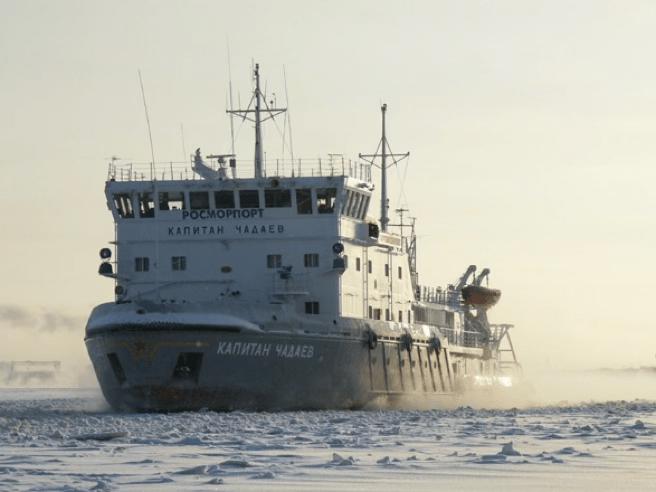
MIPT (Moscow Institute of Physics & Technic) researchers have developed a physical and mathematical model that will reduce costly full-scale testing, predict accident risks, and design stronger and safer icebreakers for the Arctic, reported the university’s website.
The results of the study were published in the “Lobachevskii Journal of Mathematics”. The developed model accurately predicts how ice breaks upon contact with a ship’s hull.
“To model this process, researchers conduct complex computer calculations based on finite or discrete element methods. However, existing models cannot fully account for the complexity of ice behavior—its ability to behave as a brittle body, breaking into fragments, and simultaneously as a ductile material, slowly deforming under pressure. This inaccuracy forces engineers to overdesign and conduct costly full-scale testing,” the publication on the MIPT website notes.
To get a solution, a computer model was created that takes into account all key stages of interaction between the vessel and the ice, including elastic, plastic, and brittle states. The Prandtl-Reuss mathematical model and the solution of equations using the Garelkin discontinuous method were applied to describe the complex behavior of ice under load.
Source: https://portnews.ru/news/387365/
 marinejournal.info