January 19 2026
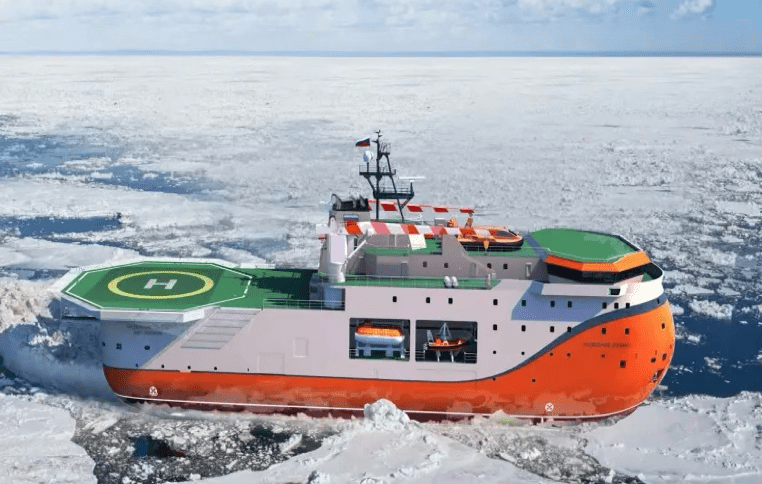
Since the late 1930th, Soviet and Russian scientists have regularly organized drifting stations to conduct research in the polar regions. In 2022 they received a new convenient tool for organizing such expeditions – the North Pole ice-resistant self-propelled platform. The special vessel serves as a convenient mobile base and provides a wide range of research in various fields.
Convenience and security
In the past all domestic drifting stations were located on ice floes. In the area of the start of the expedition’s start they were looking for a suitable ice mass, on which they set up a residential camp, scientific facilities, etc. This method of placing the expedition made it possible to perform all tasks, but it was associated with certain risks.
Quite a long time ago, the idea to conduct research from a specialized platform vessel adapted to conditions of the Arctic Ocean appeared. Such a vessel could protect scientists and equipment from the harsh climate and various dangers.
We moved from general ideas to real works at the end of the last decade. In April 2018, the Federal Service for Hydrometeorology and Environmental Monitoring (Roshydromet) ordered the Vympel Design Bureau (Nizhny Novgorod) to develop a project for a new ice-resistant self-propelled platform (LSP) under the number 00903. At the same time, a contract was signed with the Admiralty Shipyards plant (St. Petersburg), which was to build such a vessel.
Technical features
In terms of overall architecture, the North Pole is a special ice-class vessel designed for long stays in the Arctic seas. It is characterized by high resistance to external influences, increased autonomy and the ability to accommodate various means and cargo.
The Project 00903 LSP received a hull of an unusual shape and design. The hull has a rounded nose and a convex bottom. In this case, thickened and strengthened plating is used, and the load-bearing elements of the frame are located more densely than in other vessels. Due to such measures, it was possible to obtain the Arc 8 ice class – the vessel can overcome one-and two-year ice up to 3.1 m thick (in summer-autumn navigation). The hull is equipped with a single-tiered superstructure of a large area. Inside the hull, on several decks, there are rooms and compartments for different purposes. In particular, onboard ports for boats are provided. A large platform for receiving helicopters is organized on the stern.
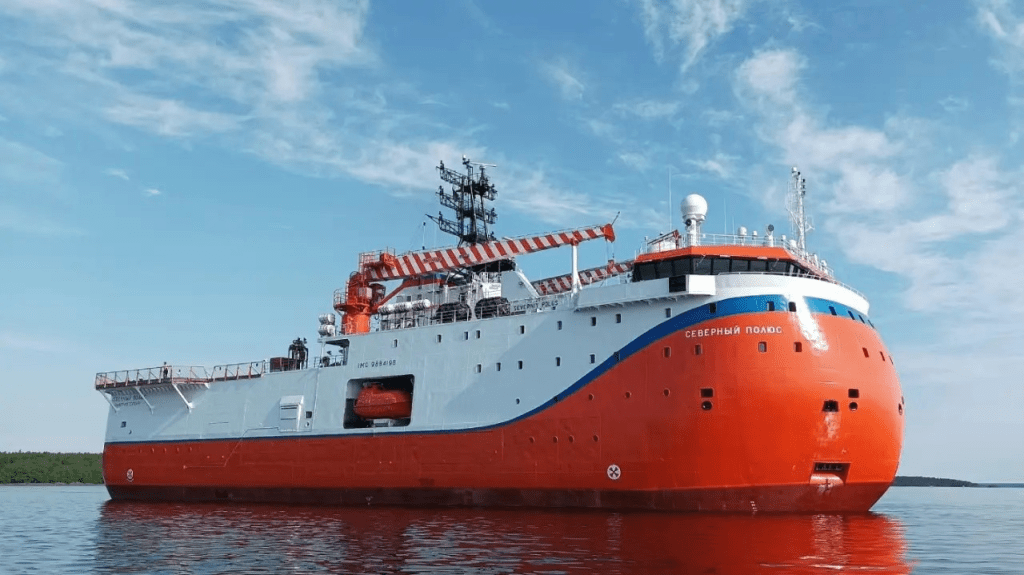
The total length of the North Pole exceeds 83 m with a width of 22.5 m. Draught is 8,6 m. Full displacement is approaching 10.4 ton. Deadweight is 3450 ton. A stern rudder propeller is used for propulsion. The engine power is 4200 kW.
The LSP can reach speed up to 10 knots. At the same time, most of the expedition time, the main power plant is responsible not for movement, but for supplying electricity to all consumers. The vessel takes on board a fuel supply sufficient for autonomous operation for 2 years.The vessel’s own crew includes 14 people. The standard composition of the scientific group is 34 people, for their accommodation single cabins with all the necessary equipment are provided. There are also places for gathering and rest.
The North Pole is equipped with 15 laboratories for various purposes. Each of them has its own equipment corresponding to the field of activity and the work being carried out. The LSP research team can conduct research on the atmosphere and ionosphere, sea ice and water, etc.
Harsh Arctic conditions
The research team also has the means to conduct research outside the vessel. These include several samples of unmanned vehicles, transport, etc. The LSP also transports a mobile camp designed for deployment on ice. It includes prefabricated structures and shelters for personnel and equipment. Research is carried out directly in the camp or using laboratories on board the vessel.
Benefits at a glance
The North Pole ice-resistant self-propelled platform is undoubtedly one of the main and most important acquisitions of Roshydromet in recent years or decades. This vessel significantly improved the ability to organize Arctic expeditions, and also had a positive impact on various studies.
Thus, the presence of a specialized vessel simplifies the delivery of a scientific expedition to the drift start site and the subsequent return home. Icebreakers and transport vessels do not have to be involved in such activities. All operations are carried out using one LSP. It is important that the North Pole serves not only as a transport, but also as a kind of field camp. This approach to organization is much safer than the usual landing on an ice floe for such expeditions. In the event of unforeseen circumstances, the scientific team is not exposed to known risks, and urgent evacuation is simplified.
Thus, the North Pole LSP is a fundamentally new tool at the disposal of Roshydromet, which allows you to solve a variety of problems. A special vessel simplifies and speeds up the organization of scientific expeditions, reduces risks and increases the efficiency of work.
Source: https://topwar.ru/276504-ledovaja-samodvizhuschajasja-platforma-severnyj-poljus.html
 marinejournal.info